
About this fungus
Penny Bun Bolete is a fungus in the Boletaceae family. Its habitat and field characteristics are summarised below.
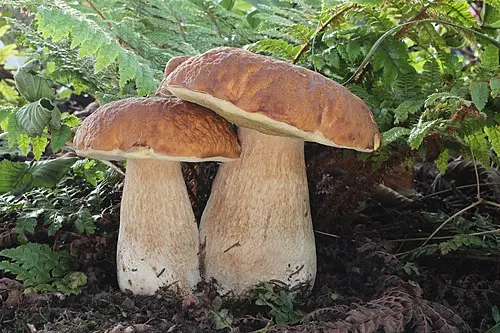
A heavy, solid bolete with a smooth brown bun-shaped cap, a thick often swollen pale stem and a sponge-like pore layer rather than gills.
What to check
Look for a fine pale raised network on the upper stem, white pores when young that become yellow and then olive, and firm white flesh that does not turn blue when cut. The cap often has a narrow paler rim. There is no ring or volva.
Variation
Caps range from pale tan and yellow-brown to reddish or dark brown and can carry a whitish bloom when young. Stems vary from barrel-shaped to club-shaped, while the pale reticulation may be clearest only near the top.
Lookalikes
Bitter Bolete has pores that become pink and a coarse dark-brown network on the stem. In northeastern North America, Boletus huronensis can resemble a porcini but has yellowish flesh, lacks the fine pale network and may stain slowly blue; it has caused severe gastrointestinal illness. North America also has several edible-looking regional members of the wider edulis group, so European names should not be assigned from cap colour alone.
Habitat and range
A mycorrhizal fungus on soil beneath broadleaf and coniferous trees, including beech, birch, oak, pine and spruce. It occurs across northern temperate regions, but similar regional porcini taxa are especially diverse in North America.
Food safety
Choice edible.
Use this profile to learn what to examine and compare, not as proof that a mushroom is safe to eat. Check the whole specimen and every important lookalike before reaching an identification.
Photographs
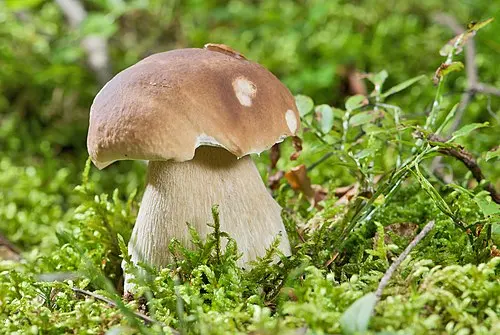 Ernie / Public Domain
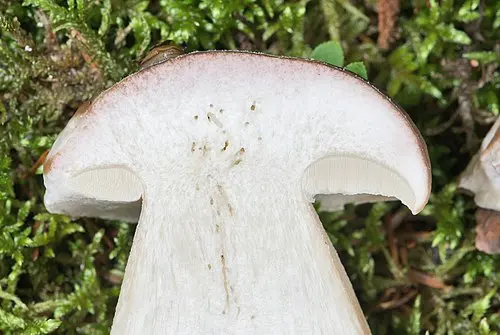 Bernie / Public Domain
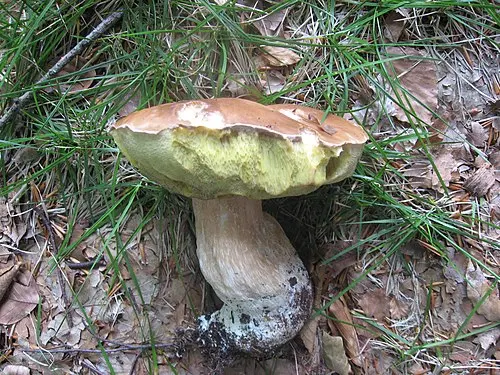 Dezidor / CC BY-SA 2.5
Species to compare
Similar mushrooms to compare against: