

About this fungus
Peppery Bolete is a fungus in the Boletaceae family. Its habitat and field characteristics are summarised below.
A small, slender bolete with a cinnamon to orange-brown cap, rusty cinnamon pores and a yellow flush at the stem base. Its pore surface and yellow basal mycelium are more useful than the common name for a safe field assessment.
What to check
Check the small size, smooth warm-brown cap, angular cinnamon to reddish-brown pores, yellow flesh or mycelium at the stem base and absence of a ring or volva. The flesh normally does not turn blue.
Variation
Caps range from yellow-brown through orange-brown to cinnamon and may be slightly viscid when damp. Pores become deeper rust-brown as spores mature. The yellow colour at the stem base can be bright or partly hidden by soil.
Lookalikes
Chalciporus piperatoides is a closely related North American taxon reported to blue in the flesh and pores. Rubinoboletus rubinus has stronger pink to red pore and stem colours. Small Suillus species may have similarly warm caps but usually show a more viscid surface and different pore, veil and host characters. Regional keys and microscopy are advisable.
Habitat and range
Found in coniferous and mixed woodland, often near fly agaric, Amanita muscaria. It was formerly described simply as ectomycorrhizal, but current evidence points to a mycoparasitic association involving fly agaric. It occurs in the Northern Hemisphere and has travelled with introduced forest fungi into parts of the Southern Hemisphere.
Food safety
Edible.
Use this profile to learn what to examine and compare, not as proof that a mushroom is safe to eat. Check the whole specimen and every important lookalike before reaching an identification.
Photographs
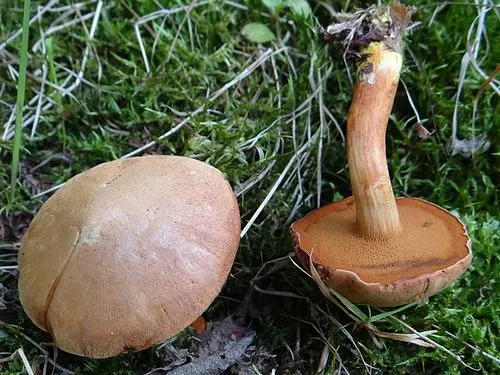 Jerzy Opioła / CC BY-SA 4.0
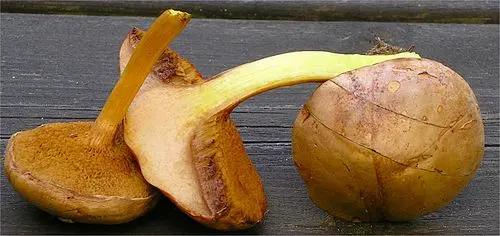 Mushroom Observer contributor, name not supplied in source / CC BY-SA 3.0