
About this fungus
Peppery Milkcap is a fungus in the Russulaceae family. Its habitat and field characteristics are summarised below.
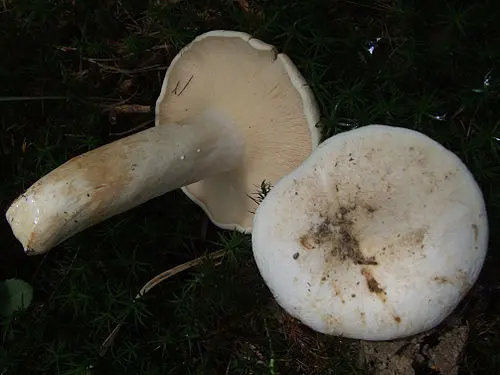
A large, dense, chalky-white milkcap that becomes broadly depressed or funnel-shaped. Its narrow, exceptionally crowded gills run down a solid tapering stem and release abundant white latex when damaged.
What to check
Check for a smooth white to cream cap, very crowded narrow decurrent gills, abundant white latex, firm brittle flesh, no ring or volva, and broadleaved trees nearby. Latex and flesh may slowly show greenish tones.
Variation
Young caps are white with an inrolled edge. Older caps become cream or faintly yellow, often collecting soil in the depressed centre and sometimes developing rusty marks. Latex quantity falls in dry or ageing specimens.
Lookalikes
Lactifluus glaucescens is extremely similar but shows more definite greenish drying and differing chemical reactions. Lactifluus vellereus has a woollier cap and more widely spaced gills. Russula delica does not produce latex. Geographic context matters because white milkcaps outside Europe include other taxa.
Habitat and range
Mycorrhizal in broadleaved woodland, especially with beech and oak, and most securely documented in Europe and nearby regions. Reports under this old name from other continents may represent different white Lactifluus species.
Food safety
Edible.
Use this profile to learn what to examine and compare, not as proof that a mushroom is safe to eat. Check the whole specimen and every important lookalike before reaching an identification.
Photographs
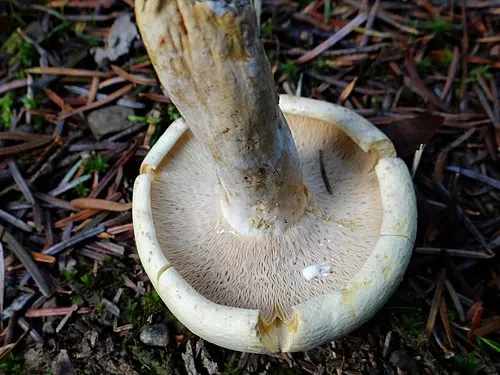 Jerzy Opioła / CC BY-SA 4.0