

About this fungus
Petticoat Mottlegill is a fungus in the Bolbitiaceae family. Its habitat and field characteristics are summarised below.
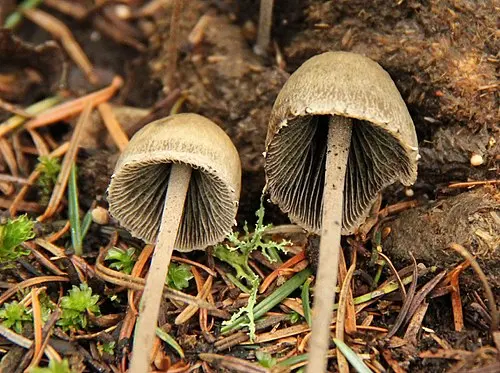
A slender dung-loving mottlegill with a grey-brown bell-shaped cap and small pale veil teeth hanging around the cap edge when young.
What to check
Look for mottled grey to black gills, a black spore print, a dry bell-shaped cap and pale tooth-like veil fragments around the margin. The slender stem has no ring or volva. Microscopy may be needed within the P. papilionaceus complex.
Variation
Caps are darker grey-brown when damp and fade to pale grey or buff as they dry. The veil teeth can wear away, making older mushrooms much less distinctive.
Lookalikes
Panaeolus cinctulus and P. cyanescens are psychoactive species but differ in characters including cap form, blue staining or spore details. Panaeolina foenisecii has a dark brown rather than black print. Toxic Galerina species generally have rusty-brown spores and often grow on wood or moss. These distinctions do not make P. papilionaceus safe to consume.
Habitat and range
Saprotrophic directly on dung or richly manured ground in grazed grassland, parks and other open habitats. It is widespread across temperate and warmer regions.
Food safety
Inedible.
Photographs
 Alan Rockefeller / CC BY-SA 3.0
Species to compare
Similar mushrooms to compare against: