

About this fungus
Pine Bolete is a fungus in the Boletaceae family. Its habitat and field characteristics are summarised below.
A large, solid member of the Cep group, with a reddish-brown to chestnut cap and a thick pale stem marked by a raised net.
What to check
The underside has pores, not gills. Pores begin white, become yellow and then olive, while the white flesh does not turn strongly blue when cut. Confirm a pale raised network, often most obvious on the upper stem, and no ring or volva.
Lookalikes
Boletus edulis and other members of the Cep complex can be extremely similar. Pine Bolete usually has a redder cap and a robust, prominently reticulate stem, but host and macroscopic appearance may not resolve every collection. North American pine-associated king boletes include different species.
Habitat and range
Mycorrhizal mainly with pine and spruce on acidic woodland soil across Europe and parts of Asia, with occasional records under broad-leaved trees. Apply the name cautiously outside Eurasia.
Food safety
Choice edible.
Use this profile to learn what to examine and compare, not as proof that a mushroom is safe to eat. Check the whole specimen and every important lookalike before reaching an identification.
Photographs
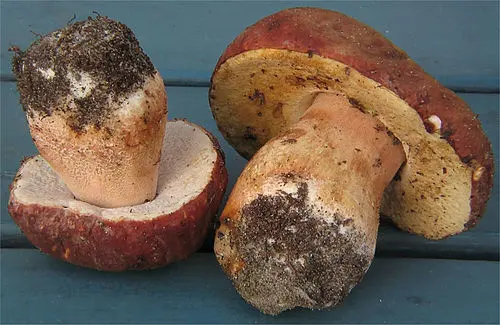 Irene Andersson / CC BY-SA 3.0