
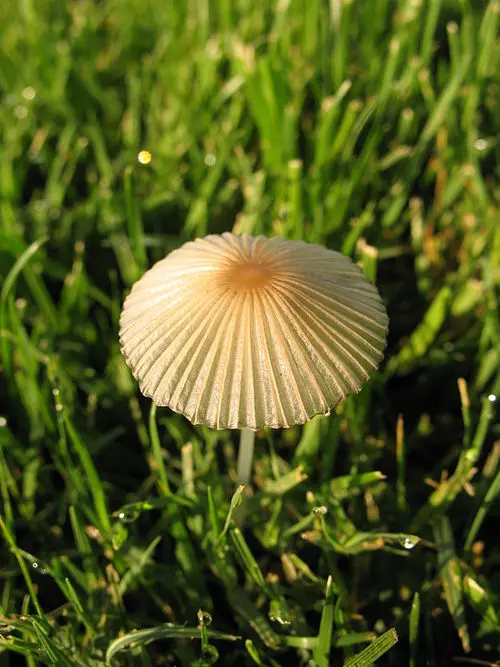
About this fungus
Pleated Inkcap is a fungus in the Psathyrellaceae family. Its habitat and field characteristics are summarised below.
A very delicate inkcap relative with a paper-thin, deeply pleated cap on a slender pale stem. It often appears overnight in grass and soon collapses or dries away.
What to check
Look for a pale grey to buff cap with a warmer brown central disc and pleats that run almost to the centre. The gills meet a collar around the stem rather than attaching directly to it. Confirm a black spore print, no ring and no volva. These features place it in Parasola, but photographs alone may not establish the exact species.
Variation
Young caps are narrow and buff to cinnamon-brown. As they open, the pleated outer area becomes paler or greyer while the centre usually remains warmer brown. Old caps flatten, split or curl and normally shrivel rather than dissolving into black liquid.
Lookalikes
Parasola leiocephala and several other members of the P. plicatilis group can be extremely similar and may require microscopic study. Parasola auricoma usually grows with wood chips or woody debris and has minute cap hairs visible under magnification. A field record without microscopy is often best treated as Parasola plicatilis group.
Habitat and range
Saprotrophic in lawns, verges, short grass and disturbed ground, with occasional fruiting among leaf litter or wood chips. It is widely reported in temperate regions, although records may include close species in the same group.
Food safety
Inedible.
Photographs
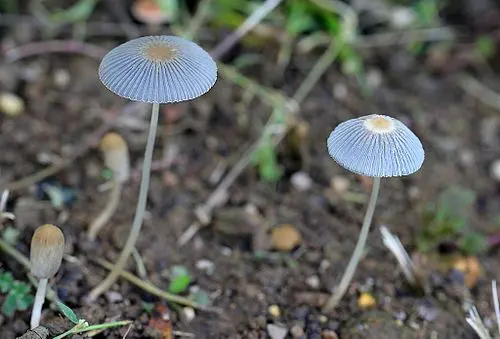 Stu's Images / CC BY-SA 3.0
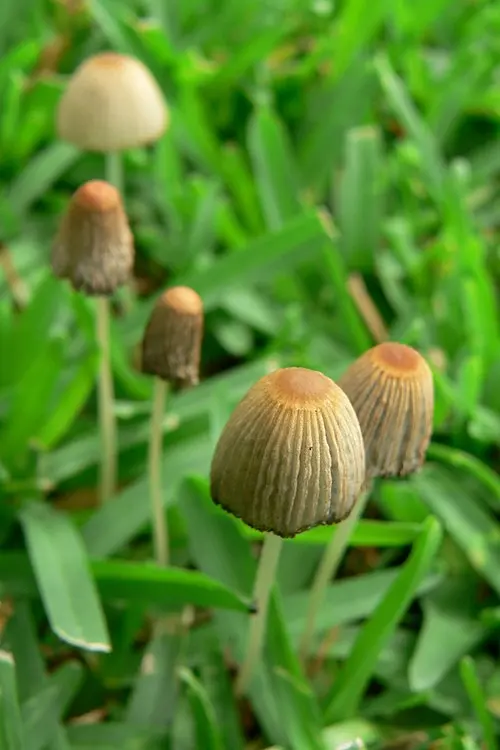 Jason Hollinger / CC BY 2.0