

About this fungus
Poison Pie is a fungus in the Hymenogastraceae family. Its habitat and field characteristics are summarised below.
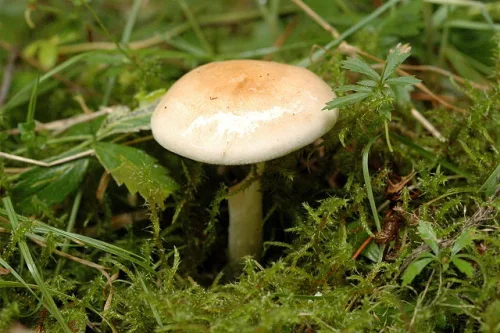
A pale cream, buff or light ochre woodland mushroom with a smooth cap that becomes glossy and sticky in damp weather. The cap is usually warmer and slightly darker at the centre, while the crowded gills begin pale and become clay-brown as the spores mature. It often appears in scattered groups or compact tufts near trees.
What to check
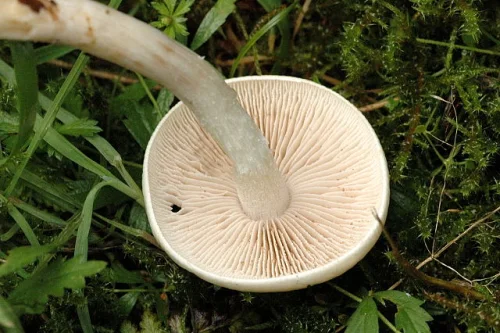
Look for a sticky pale cap, crowded notched or broadly attached gills, a dry pale stem with no ring, and a brownish olive to reddish-brown spore print. In damp weather, clear droplets may form along the gill edges. These can disappear as the mushroom dries and leave small brown or rusty spots. A radish-like smell is common but may be weak or absent. These characters place a collection in the right Hebeloma group, but they do not confirm this exact species on their own.
Variation
Young caps are convex with the edge rolled inward. They often develop a low central bump and become broader as they mature. Colour ranges from pale cream through buff-yellow to light ochre-brown, usually with a paler margin. Wet caps can look much darker and shinier than dry ones. Young gills may be cream or pale clay coloured, then deepen to umber or sepia while their fringed edges remain paler. Droplets are most obvious in humid conditions and may be completely absent in dry weather.
Lookalikes
Poison Pie belongs to a difficult group of pale, ringless Hebeloma species. Hebeloma eburneum, Hebeloma geminatum, Hebeloma aanenii and several others can share the sticky cap, radish-like smell and weeping gills. Separating them may require spore measurements, examination of the cells along the gill edge and sometimes DNA. Bitter Poisonpie, Hebeloma sinapizans, is often larger and more bulbous, and a cut stem may show a small hanging tongue of flesh inside its hollow upper part. It usually lacks the conspicuous weeping gill edge, but field characters still overlap. A brown spore print helps separate Hebeloma from superficially similar white-spored mushrooms, not from its closest relatives.
Habitat and range
Ectomycorrhizal on soil near living trees. It is recorded in broadleaf and conifer woodland, parks, avenues, heathland and grassy woodland edges, sometimes in clusters or partial fairy rings. Modern research has concentrated on European collections and has shown that the old name concealed several distinct species even there. Similar mushrooms in North America and other regions have often inherited the name from older field guides, so overseas records need regional Hebeloma keys and may require microscopy or DNA.
Food safety
Poisonous.
Photographs
 James Lindsey / CC BY-SA 3.0
 James Lindsey / CC BY-SA 3.0
 James Lindsey / CC BY-SA 3.0