

About this fungus
Poplar Fieldcap is a fungus in the Strophariaceae family. Its habitat and field characteristics are summarised below.
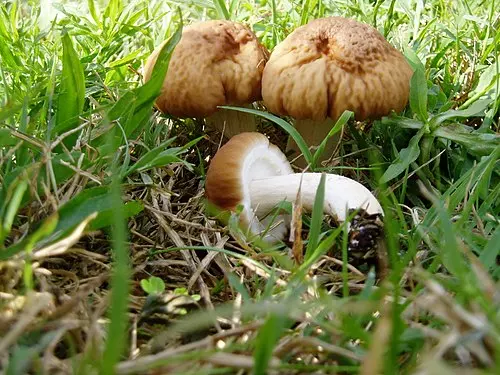
A robust brown-spored mushroom that often forms tight clusters on poplar, willow or other buried hardwood, with smooth buff to brown caps that may crack in dry weather.
What to check
Look for cream gills that mature through grey-brown to tobacco brown, a persistent hanging ring that may collect brown spores, and clustered growth directly from wood or buried woody material.
Variation
Young caps can be pale cream or buff with a darker centre. Older or dry caps become browner and often develop a cracked surface, while the gills darken as the spores mature.
Lookalikes
Spring Fieldcap and other Agrocybe species may occur in grass or woodchip, but are generally smaller and lack this combination of a persistent hanging ring, strongly browning gills and clustered growth from substantial hardwood. Check several characters rather than relying on cap colour.
Habitat and range
A wood-decaying species found on dead or dying poplar and willow, buried hardwood roots and stumps, and hardwood mulch. It is more frequent in warmer parts of Europe but is recorded more widely and is also cultivated.
Food safety
Edible.
Use this profile to learn what to examine and compare, not as proof that a mushroom is safe to eat. Check the whole specimen and every important lookalike before reaching an identification.
Photographs
 Adnan Sinar / CC BY-SA 3.0