

About this fungus
Porcelain Fungus is a fungus in the Physalacriaceae family. Its habitat and field characteristics are summarised below.
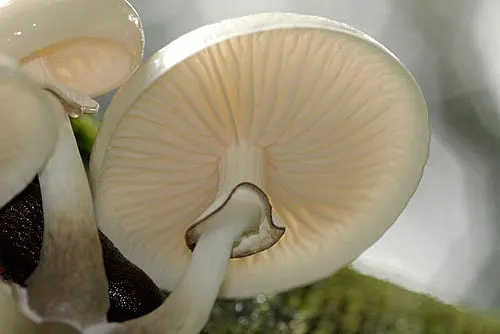
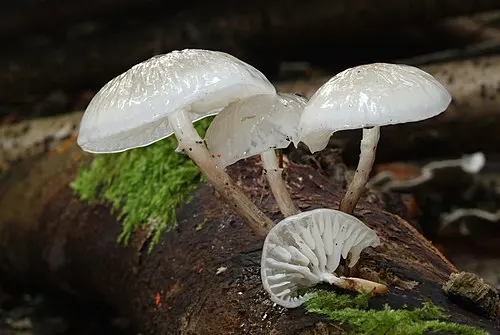
A glassy white mushroom with a translucent, strongly slimy cap, often growing in clusters from beech trunks and branches. The white shapes can be conspicuous high in the canopy.
What to check
Confirm growth from beech wood, a white to ivory cap coated with clear slime, broad and widely spaced white gills, a white spore print and a substantial ring on the upper stem. The thin cap can be translucent enough for the gills to show through at the margin.
Variation
Young caps are rounded and may have a grey, olive or pale ochre flush at the centre. Older caps become broadly domed and remain white to ivory. The stem may curve so that the gills face downward when the fruit body grows from the side or underside of a branch.
Lookalikes
White oyster mushrooms can grow from trunks but lack the stem ring and usually have crowded gills that run down an off-centre stem. Pale honey fungi have more crowded gills and drier, less translucent caps. The combination of heavy clear slime, distant gills, a ring and beech wood is much more informative than colour alone.
Habitat and range
A European fungus strongly associated with beech. It decomposes dead trunks and branches and can act as a weak parasite on dead portions of living trees, often fruiting well above head height. Mucidula mucida is the accepted name in some modern taxonomies.
Food safety
Edible.
Use this profile to learn what to examine and compare, not as proof that a mushroom is safe to eat. Check the whole specimen and every important lookalike before reaching an identification.
Photographs
 James Lindsey / CC BY-SA 3.0
 H. Krisp / CC BY 3.0