

About this fungus
Purple Brittlegill is a fungus in the Russulaceae family. Its habitat and field characteristics are summarised below.
A robust brittlegill with a wine-red to purple cap that is usually darkest, sometimes almost black, at the centre. Its pale gills and stem contrast strongly with fresh dark caps.
What to check
Look for a 4 to 10 cm cap that becomes flat or shallowly depressed, often fading towards the margin while retaining a dark centre. The crowded pale cream gills are brittle and narrowly attached, the white stem often greys with age, and the spore print is white to pale cream. There is no ring or volva. Cap colour overlaps with several Russula, so microscopy and regional keys may be needed.
Variation
Caps range from dark wine-red and purple to red-brown, sometimes with cream or yellow mottling. Rain and age can wash colour from the margin. The stem and gills may become greyish as the mushroom matures.
Lookalikes
Russula fragilis is smaller and more delicate, with finely toothed gill edges. Russula xerampelina develops a fishy smell and brown staining, while Russula brunneoviolacea and other purple-capped species can be difficult to separate without spores and cap-skin characters.
Habitat and range
Ectomycorrhizal, especially with oak on acidic soil, and also reported with beech and pine. It fruits on woodland soil in temperate regions, mainly from summer into autumn where seasons are pronounced.
Food safety
Edible.
Use this profile to learn what to examine and compare, not as proof that a mushroom is safe to eat. Check the whole specimen and every important lookalike before reaching an identification.
Photographs
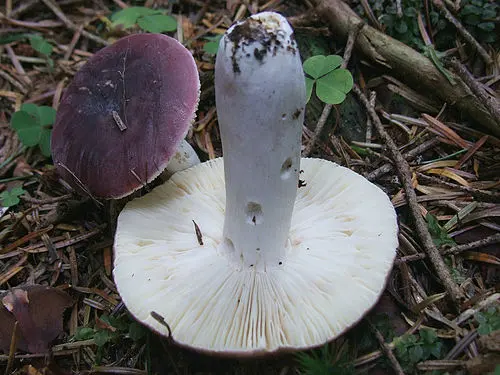 Jerzy Opioła / CC BY-SA 4.0
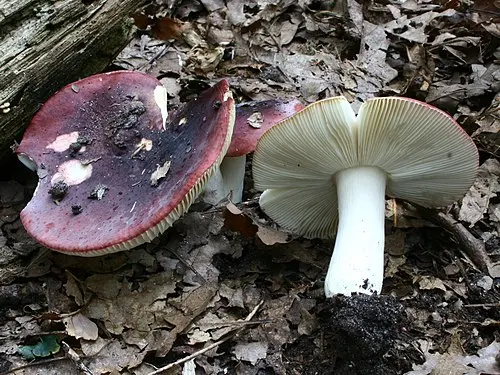 Strobilomyces / CC BY-SA 4.0
Species to compare
Similar mushrooms to compare against: