
About this fungus
Ravenel's Stinkhorn is a fungus in the Phallaceae family. Its habitat and field characteristics are summarised below.
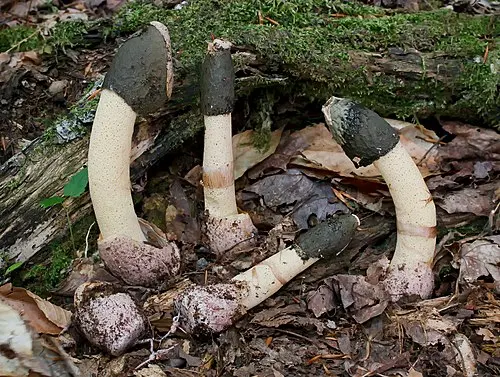
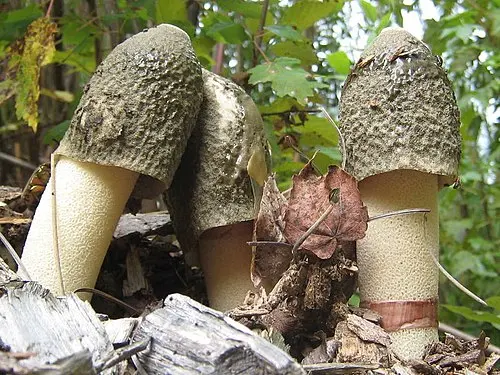
A North American stinkhorn that expands rapidly from a whitish, pink or lilac egg. The mature fruit body has a tall hollow cream to pale yellow stem and a separate broad conical or bell-shaped head coated in foul-smelling olive-brown spore slime.
What to check
Confirm a distinct cap-like head sitting on a pocketed, spongy stem. Beneath the slime, the cap surface is smooth to finely granular and only slightly wrinkled, not strongly netted with deep pits and ridges. The cap develops a small opening at its tip, while pink to purple remains of the original egg form a tough cup at the stem base. There is no ring. Flies and other insects commonly remove patches of the gleba and expose the paler cap surface below.
Variation
Young eggs can be almost white or clearly pink, lilac or purplish. Mature stems range from creamy white to pale yellowish, and the gleba may appear olive-brown, dark brown or nearly black in photographs. Once insects remove the slime, an older head looks much paler and less conspicuous. Fruiting bodies may occur alone but frequently appear in loose groups or clusters.
Lookalikes
Phallus impudicus and Phallus hadriani usually have a more coarsely reticulate head, with a clear network of pits and ridges beneath the gleba. Phallus hadriani can also have a pink or violet egg, so egg colour alone is not diagnostic. Mutinus species lack the separate thimble-like cap. This is primarily a North American species, and similar stinkhorns reported elsewhere should be compared with a regional guide.
Habitat and range
Saprotrophic on decaying plant material, especially woodchips, sawdust, buried wood and well-rotted logs. It is common in gardens, flowerbeds, parks, lawns and other cultivated or disturbed ground, and also occurs in woodland. The best-supported range extends from Mexico through the eastern and central United States to eastern Canada. It mainly fruits in autumn in cooler regions but can appear in other seasons during warm wet conditions.
Food safety
Inedible.
Photographs
 Bobby McCabe / CC BY 4.0
Species to compare
Similar mushrooms to compare against: