

About this fungus
Red Cracking Bolete is a fungus in the Boletaceae family. Its habitat and field characteristics are summarised below.
A small to medium bolete with a dry brown to olive-brown cap, yellow pores and a yellowish stem streaked red. Mature caps may crack to expose pink-red flesh, but many genuine specimens do not show dramatic cracking.
What to check
Check for a dry finely velvety cap, large angular yellow pores that age olive-yellow and usually bruise blue-green, and a slender yellow stem with red fibres or flushing. The cap flesh may show red or pink through cracks, while cut stem flesh normally blues little or only slowly. The spore print is olive-brown and there is no ring or volva. Microscopy may be needed because several related boletes share these field marks.
Variation
Cap colour ranges from grey-brown and sepia to olive-brown or reddish-brown. Cracking is affected by age and dry weather and is absent in many specimens. Pore bruising and red stem colour also vary, so neither should be treated as a single decisive test.
Lookalikes
Xerocomellus cisalpinus often blues strongly in the lower stem and has finely striate spores. Xerocomellus pruinatus generally has a darker, less readily cracking cap, while other regional Xerocomellus can require microscopy or DNA. Pseudoboletus parasiticus grows with earthballs. The name X. chrysenteron has been widely misapplied outside Europe, especially in North America.
Habitat and range
An ectomycorrhizal fungus of woodland soil. Verified accounts include both conifers and broadleaved hosts, with the apparent balance varying by region and by how older records in the species complex are interpreted. It fruits mainly from summer into autumn in temperate regions.
Food safety
Edible.
Use this profile to learn what to examine and compare, not as proof that a mushroom is safe to eat. Check the whole specimen and every important lookalike before reaching an identification.
Photographs
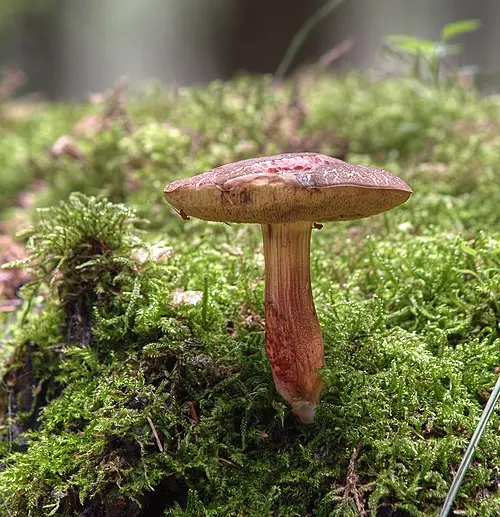 Jörg Hempel / CC BY-SA 2.0 de
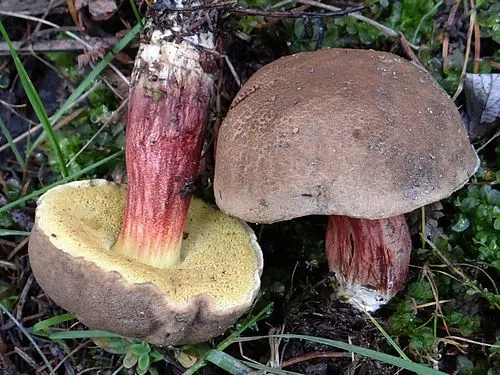 Jerzy Opioła / CC BY-SA 3.0
Species to compare
Similar mushrooms to compare against: