

About this fungus
Red-mouth Bolete is a fungus in the Boletaceae family. Its habitat and field characteristics are summarised below.
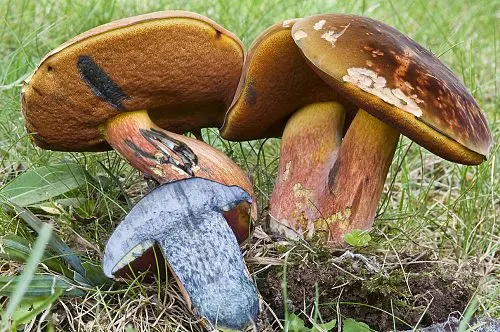
A striking eastern North American bolete with a dry, velvety brown to reddish cap, a red or red-orange pore surface and a red-speckled stem. Any bruised part can turn dark blue to almost black within moments. Index Fungorum now places it in Neoboletus, although GBIF still uses its long-standing name Boletus subvelutipes.
What to check
Confirm pores rather than gills, then expose fresh tissue by cutting through cap and stem. The flesh is bright yellow before it rapidly turns deep blue, and the pores and stem bruise just as strongly. Inspect the whole stem: it should carry red dots or fine flakes rather than a raised net, and mature specimens usually have short, stiff, dark-red hairs around the base. The stem is solid and there is no ring. A dark olive-brown spore print and spindle-shaped spores support the identification. Red pores and blue staining alone identify a broad group, not this species.
Variation
Caps range from cinnamon and yellow-brown through red-brown to reddish-orange, and may fade, darken or crack with age. Fresh pores can be deep red, red-orange or orange, then become dull orange-brown or olive as the tubes mature. Basal hairs may be yellow on a young specimen before becoming dark red. The blue reaction can mask the original yellow flesh almost instantly and may later fade towards pale or greyish tissue, which helps explain differing published flesh colours.
Lookalikes
Several eastern North American Neoboletus share red pores, yellow flesh and very fast blue staining. Neoboletus austrinus has purple flakes over the stem, while N. hypocarycinus has white basal mycelium and shorter spores. Other subvelutipes-like collections may require microscopy or DNA, and older field guides sometimes combined more than one species under this name. Suillellus species usually have a raised red network on at least the upper stem rather than red dots and basal hairs. European names such as Neoboletus luridiformis should not be applied automatically to a North American collection. Rubroboletus satanas is mainly a European species with a pale cap and a swollen, netted stem, not the best default comparison for this eastern North American bolete.
Habitat and range
Mycorrhizal on soil with trees. The best-established North American range extends through eastern Canada and the eastern United States, south to Florida and west towards Minnesota, with records also reported from Mexico and parts of Asia. It fruits singly, scattered or in small groups, most often with hardwoods such as oak and hickory, and some accounts also report conifer partners including hemlock. In eastern North America it is mainly a summer to early-autumn mushroom.
Food safety
Poisonous.
Photographs
 the3foragers / CC BY-SA 3.0