

About this fungus
Rooting Shank is a fungus in the Physalacriaceae family. Its habitat and field characteristics are summarised below.
A tall, slender woodland mushroom with a grey-brown cap that is sticky when damp and strongly wrinkled in radial lines. Its most distinctive feature is a long tapering stem extension running through the soil to buried wood.
What to check
Expose the complete base carefully and look for a deep, root-like extension rather than an abruptly ending stem. The broad white to cream gills are rather distant and attached to narrowly notched, not decurrent. The ringless stem is pale above, browner below and finely lined.
Variation
Caps range from pale grey-brown to mid brown and may become silky rather than sticky as they dry. The underground extension varies greatly in length and can be broken off, leaving an ordinary-looking stem base.
Lookalikes
Other Hymenopellis species, especially in North America and Asia, can share a rooting stem but differ in stem hairs, spores and ecology. Megacollybia species lack the long tapering root and may have white cord-like rhizomorphs. A specimen without its full base should remain uncertain.
Habitat and range
Saprotrophic from buried or decaying wood beneath leaf litter, often with beech and other broad-leaved trees. Hymenopellis radicata is principally a European concept; related rooting species occupy similar habitats in other regions.
Food safety
Edible.
Use this profile to learn what to examine and compare, not as proof that a mushroom is safe to eat. Check the whole specimen and every important lookalike before reaching an identification.
Photographs
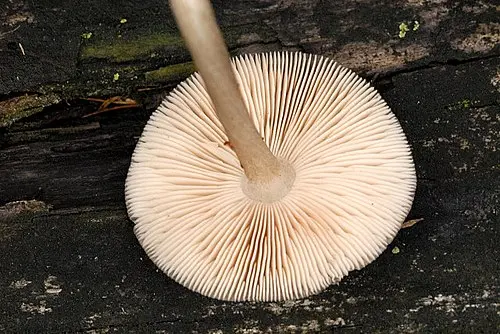 James Lindsey / CC BY-SA 3.0
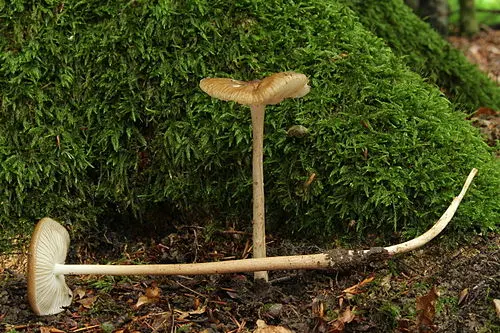 H. Krisp / CC BY 3.0
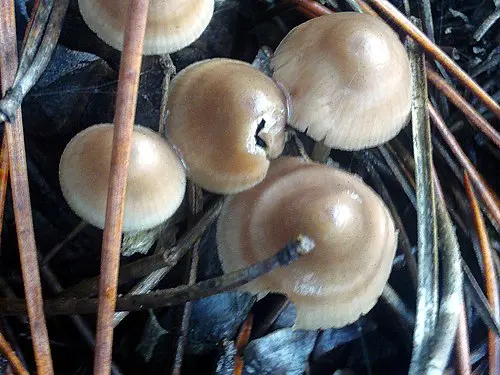 Javier martin / Public Domain