
About this fungus
Rosy Wood Mushroom is a fungus in the Agaricaceae family. Its habitat and field characteristics are summarised below.
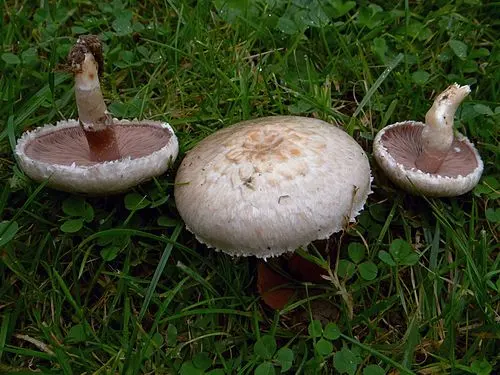
A small, slender field mushroom with a pale cap patterned by fine pink-grey, wine-coloured or brownish fibres and scales, usually strongest near the centre. The free gills develop from pale grey or muted pink to dark brown, while the pale stem carries a thin, easily lost ring. Handling often brings out yellow staining, and fresh material may smell of almonds or anise.
What to check
Check the complete combination rather than yellow staining alone. The cap is usually 2 to 7 cm across, initially rounded or convex and later nearly flat, with a pale margin and darker radial fibres near the centre. Gills are free and crowded, becoming dark brown as the spores mature. The slender stem is commonly 1. 5 to 8 cm tall, often slightly swollen at the base, with a high, thin and fragile ring. Yellow staining may show on the cap, flesh and especially the lower stem. The spore print is dark brown. Small elliptical spores without a germ pore and cheilocystidia arranged in short chains support the European concept. There is no volva.
Lookalikes
This belongs to a difficult group of small, yellowing Agaricus species. European authors often apply Agaricus dulcidulus to the same or a closely related mushroom, while molecular work describes A. semotus as a confused and dubious name. Other members of subgenus Minores can share the small size, almond scent and yellow bruising. Larger yellow-staining Agaricus such as A. xanthodermus and A. Reliable separation may require spores, cystidia and DNA interpreted with a regional key.
Habitat and range
A saprotrophic mushroom of soil and humus, reported from woodland litter, woodland edges, grassy ground and open dunes. It can occur singly or in small groups beneath broadleaf trees or conifers. Records exist in Europe, North America and New Zealand, but the name has not been applied consistently across those regions. A local record should therefore be checked against a current regional treatment rather than assuming that all photographs and descriptions refer to one identical species concept.
Food safety
Inedible.