
About this fungus
Royal Fly Agaric is a fungus in the Amanitaceae family. Its habitat and field characteristics are summarised below.
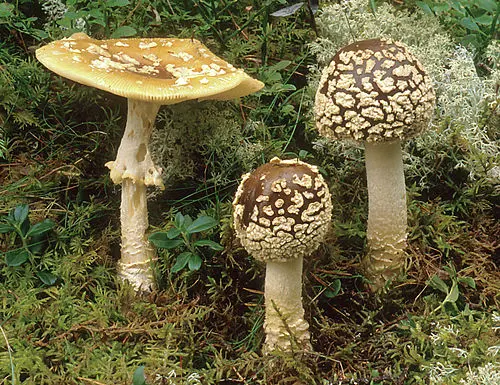
A large northern Fly Agaric relative with a glossy yellow-brown to deep chestnut cap, usually broken up by conspicuous cream or yellowish warts and patches. Its pale shaggy stem, hanging ring and banded bulb give it the same imposing build as a red Fly Agaric, but in a darker palette.
What to check
Lift the whole stem base. Rather than the sharp collar of a Panthercap, Royal Fly Agaric normally has a broad bulb wrapped in coarse, ragged rings or belts of pale to brownish veil material. The hanging ring is often grooved above and ragged at its edge. Gills are crowded and free, beginning white and sometimes becoming pale yellow. The mature cap margin is lined, and the white flesh does not develop the pink or wine-red bruising of a Blusher. Cream or yellowish veil fragments are typical, although rain can remove many of them.
Lookalikes
Red Fly Agaric has the same general build and veil pattern but normally retains red or orange cap colour beneath its white warts. Panthercap is usually smaller, has purer white warts and a more sharply defined collar or gutter at the top of its bulb. Blusher develops pink to wine-red marks in damaged flesh and insect tunnels, with greyer veil fragments. Parasol Mushroom has movable ring, a snakeskin-patterned stem and no volval bulb, but a published poisoning series shows that the two have been confused. Exact names for brown fly-agaric relatives vary outside the species' northern Eurasian stronghold, so location matters.
Habitat and range
Mycorrhizal, most characteristic of cool northern or montane forest on acidic soil. Spruce is its main documented partner, with birch, pine and other conifers also reported. It is fairly common in Scandinavia and occurs more locally in central and eastern Europe; reliable records from Britain are exceptional, and North American reports are largely confined to western Alaska. It usually fruits from summer into autumn, often singly or in groups among moss and forest-floor vegetation.
Food safety
Poisonous and psychoactive.
Photographs
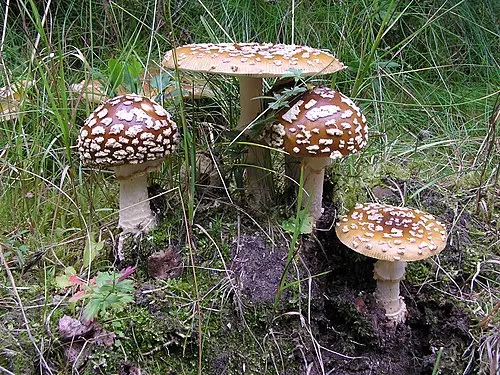 Andreas Gminder / CC BY-SA 3.0