

About this fungus
Scaly Chanterelle is a fungus in the Gomphaceae family. Its habitat and field characteristics are summarised below.
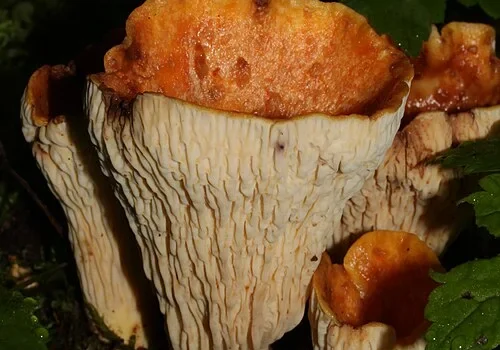
A stout orange fungus shaped like a vase or trumpet, with no clear boundary between cap and stem. The inside of the vase is moist and covered in soft orange to reddish scales. Outside, the fertile surface is pale cream to ochre and strongly wrinkled, making the whole mushroom look sculpted rather than gilled.
What to check
Follow the pale outer surface down towards the base. It carries shallow, irregular folds that fork and cross-connect, not the thin blade-like gills of an ordinary mushroom. The orange upper surface has soft scales, often arranged in rough rings or patches around the deepening hollow. The flesh is thick, fibrous and whitish. There is no ring and no volva. An ochre to yellowish spore print supports the identification, but regional comparisons still matter.
Variation
Young fruit bodies may begin as chunky cylinders with only a small hollow at the top. They broaden into deep trumpets or flaring vases, sometimes sharing a base or forming large troops. Colour ranges from bright reddish orange to dull brownish orange or cinnamon, with yellow showing between the darker scales. Old mushrooms become paler, browner and more ragged. The name also covers, or has historically covered, several genetically different regional forms, so not every specimen will fit one colour or size description exactly.
Lookalikes
Turbinellus kauffmanii is usually much paler tan or brown, with larger coarse scales and a pungent smell when young. Turbinellus bonarii is paler and pinker and has been treated either as a separate western species or within a broad Turbinellus floccosus concept. Pig's Ear, Gomphus clavatus, is more purple-grey and usually grows as a fused cluster. True chanterelles have more regular blunt ridges, lack the deep heavily scaled orange vase and belong to a different group. In difficult regions, a photograph cannot resolve the modern species boundaries on its own.
Habitat and range
Ectomycorrhizal with conifers. Documented partners include pine, spruce, fir, hemlock and Douglas-fir. It fruits on forest soil and needle litter, alone, scattered, in arcs or in dense troops, usually from summer into autumn and sometimes through winter on the mild Pacific coast. Mushrooms under this name occur across northern and mountain forests of North America and Asia. Mexican research confirmed a partnership with sacred fir in high-elevation forest, while recent DNA evidence suggests that some eastern North American, Mexican and Indian populations may represent different lineages.
Food safety
Poisonous.
Photographs
 Walter Siegmund / CC BY-SA 3.0