

About this fungus
Scaly Earthball is a fungus in the Sclerodermataceae family. Its habitat and field characteristics are summarised below.
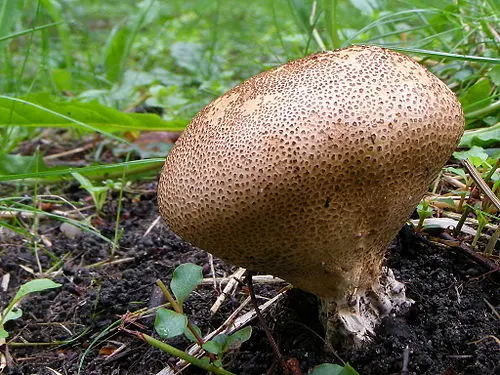
A brown, potato-like earthball with a thin, finely scaly skin and an unusually long rooting base. The stem-like base is often deeply grooved and ends in white cord-like mycelial threads in the soil.
What to check
Look for a rounded fruit body about 2 to 8 cm across, small separate dark scales on a thin skin and a long furrowed pseudostipe. A sectioned specimen has no cap, stem or gills developing inside. The interior starts cream, becomes purple-brown with fine white marbling, then matures to dark brown spore powder. The thin skin may stain pinkish or reddish when cut.
Variation
The surface is reddish brown when fairly fresh and becomes more ochre with age. Its small scales gradually rub or flake away, so an older specimen may be much smoother than its English name suggests. At maturity the top splits irregularly to release spores.
Lookalikes
Leopard Earthball, Scleroderma areolatum, is usually smaller and has a shorter base, with tiny dark scales surrounded by conspicuous pale rings. Common Earthball, Scleroderma citrinum, has a much thicker, coarser skin and little or no pseudostipe. True puffballs are softer and remain clean white inside while young, without a marbled purple-brown stage.
Habitat and range
An ectomycorrhizal fungus of well-drained sandy or nutrient-rich soil, found with broadleaved trees in woodland, parks, heathland, woodland edges and other tree-lined places.
Food safety
Poisonous.
Photographs
 Grzegorz "Spike" Rendchen / CC BY-SA 4.0
Species to compare
Similar mushrooms to compare against: