

About this fungus
Scaly Ink Cap is a fungus in the Psathyrellaceae family. Its habitat and field characteristics are summarised below.
A substantial eastern North American ink cap that often forms an impressive crowd on a decayed hardwood log. Young oval caps are wrapped in a pale felt-like universal veil. As they become bell-shaped, this covering breaks into large irregular cream or yellowish patches, exposing a brownish yellow and later grey grooved surface.
What to check
Look for a 3 to 8 cm cap with large, well-separated felty patches, not fine hairs or tiny granules. The crowded gills are free or narrowly attached, changing from white to grey and then black before liquefying. The pale stem is 5 to 13 cm tall and commonly ends in a conspicuous rimmed bulb inserted into the wood. There is no dependable skirt-like ring on the upper stem; loose universal-veil material near the base can look like a low collar. The spore print is black. Microscopy may show both ordinary thin-walled and distinctive thick-walled cystidia.
Variation
Very young caps can look almost entirely cream because the veil has not yet split. Rain, age and expansion leave fewer patches and reveal more yellow-brown or grey cap surface. The margin becomes strongly grooved, splits and curls upward as the gills darken. Like other inky caps, a fruit body can change rapidly and finally collapse into black fluid. The basal rim may be buried in soft wood and is easily missed unless the whole stem is removed intact.
Lookalikes
Coprinopsis strossmayeri is the closest practical comparison. It usually fruits from recently cut stumps, roots or urban woodchips, has much smaller fibrillose cap scales, lacks the large rimmed basal bulb and is connected to reddish brown root-like strands. Common Ink Cap, Coprinopsis atramentaria, has a smoother grey cap without the large felty patches. The European Magpie Inkcap, Coprinopsis picacea, has striking white patches on a much darker cap and a different range. Mature or rain-washed specimens may require microscopy because the veil characters become less obvious.
Habitat and range
Saprotrophic on well-decayed hardwood logs in woodland, fruiting in close groups or large clusters during summer and autumn. It was described from New York and is recorded widely east of the Rocky Mountains in North America. It is not a normal European species. Apparently ground-based clusters should be checked for buried hardwood because true C. variegata is closely tied to well-rotted wood.
Food safety
Poisonous.
Photographs
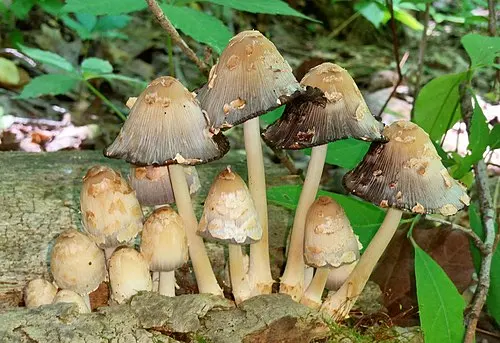 Crystal (Squirrelgirl) / CC BY-SA 3.0