

About this fungus
Scaly Knight is a fungus in the Tricholomataceae family. Its habitat and field characteristics are summarised below.
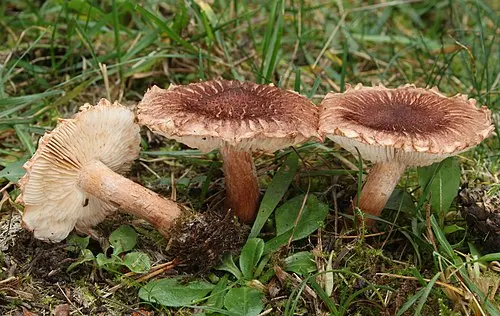
A warm reddish-brown woodland mushroom with a dry, woolly cap that breaks into coarse radial scales. The inrolled young margin carries a shaggy fringe, giving the cap a distinctly untidy edge. The pale stem is also fibrous or finely scaly and often becomes hollow.
What to check
Check for a 3 to 10 cm dry cap with dense reddish-brown fibres and scales over a paler background, plus a hairy margin that is most obvious when young. The crowded gills are attached with a notch, starting white to cream and developing reddish-brown spots or a more general orange-brown tint with age. The stem is fibrous-scaly, often spindle-shaped and commonly hollow. A weak cobweb-like veil may fringe the young cap but does not leave a lasting ring. The spore print is white. Use cap texture, stem structure, gill changes and the host tree together.
Variation
Young caps may look more even and softly felted before expansion separates the surface into scales. Mature caps flatten but can retain a low central bump, while their margins may remain downturned or become ragged. Gill staining varies from scattered brown spots to a broader reddish or orange-brown change. Stem hollowness can be less obvious in young fruit bodies.
Lookalikes
Tricholoma imbricatum is usually duller brown, firmer and less shaggy, with a stem that normally remains solid; it is more strongly associated with pine, while Scaly Knight is especially frequent with spruce. Tricholoma inodermeum has a less woolly cap and flesh that can turn bright pink-red when damaged. Smooth or greasy brown members of the T. pessundatum group can have spotted gills but lack the strongly woolly-scaly cap. Some brown Tricholoma species are poisonous, and regional names can hide separate DNA lineages, so photographs alone may not settle difficult collections.
Habitat and range
Ectomycorrhizal on soil with conifers, particularly spruce and also pine, occurring singly, in small groups or in larger troops. It fruits mainly from summer into autumn across northern temperate and boreal parts of Europe, Asia and North America. North American brown Tricholoma names are still being refined, so local host records and regional references matter.
Food safety
Edibility is uncertain or disputed.
Photographs
 Holger Krisp / CC BY 3.0