

About this fungus
Scurfy Twiglet is a fungus in the Tubariaceae family. Its habitat and field characteristics are summarised below.
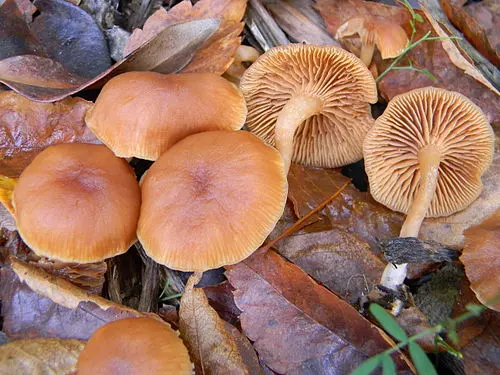
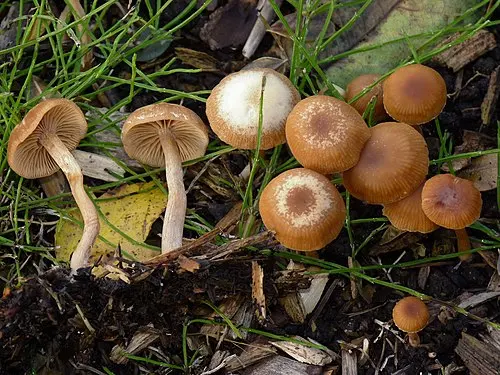
A very small brown mushroom that often appears in loose troops across damp twigs, wood chips and woody litter. Fresh caps are hazel to cinnamon-brown, while drying caps can fade so much that mushrooms in the same group appear to be different colours.
What to check
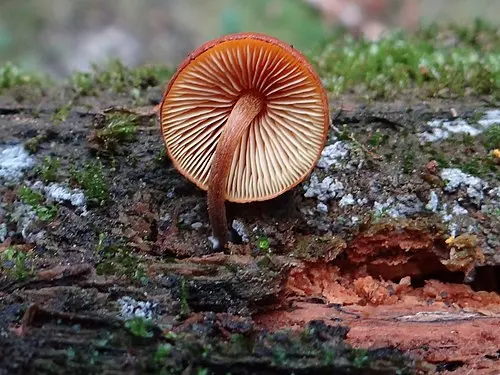
Look for a thin 1 to 4 cm cap with fine whitish veil fibres or small flakes, especially near the margin. The brownish gills are broadly attached and may run a short way down the slender fibrous stem. White downy mycelium is often visible at the base. There is no lasting ring or volva, although a faint temporary ring zone can occur.
Variation
Moist caps can be orange-brown, cinnamon or hazel and may show a darker centre. They fade towards dull buff or creamy ochre as they dry. The surface may look finely hairy or scurfy when young, but rain and age can remove much of this texture and the pale veil fragments.
Lookalikes
Tubaria dispersa is usually paler and smoother and is closely associated with hawthorn remains. Other Tubaria may require microscopy. Many unrelated small brown mushrooms share the same general shape and wood-chip habitat, including the deadly Galerina marginata and Psilocybe cyanescens. A brown cap or a matching photograph is therefore not enough for a species identification.
Habitat and range
This is a saprotrophic fungus of dead plant material. It grows on twigs, branches, buried wood, wood chips, mulch and sometimes coarse leaf litter or humus in woodland, gardens, parks and disturbed ground. Fruiting can occur in different seasons according to climate, with cool wet periods often producing the largest groups.
Food safety
Inedible.
Photographs
 Tim Sage / CC BY-SA 3.0
 lightworkerpeace / CC BY-SA 3.0
 Jerzy Opioła / CC BY-SA 3.0