
About this fungus
Shaggy Inkcap is a fungus in the Agaricaceae family. Its habitat and field characteristics are summarised below.
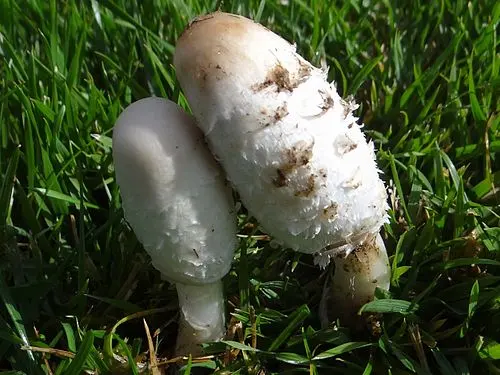
A tall, distinctive inkcap with an elongated white cap covered in shaggy upturned scales. It commonly appears in troops, lines or rings on lawns, verges and disturbed ground, then changes rapidly as its gills turn pink and black.
What to check
Look for an egg-shaped to long bell-shaped white cap with a tan central disc and large shaggy scales. The crowded gills are free or narrowly attached, passing from white through pink to black before liquefying from the lower margin inward. The hollow white stem carries a loose movable ring that may slide down or disappear. The spore print is black and there is no volva.
Variation
Rain can flatten the shaggy scales, while dry caps can look especially woolly. The cap expands only modestly before its lower edge blackens and dissolves, eventually leaving a bare stem and small dark cap remnant. This change proceeds from the margin inward, not from the base of the cap upward as the draft stated.
Lookalikes
Common Inkcap, Coprinopsis atramentaria, has a smoother grey-brown cap and grows in dense clusters from buried wood. It contains coprine and can cause a strong reaction with alcohol. Magpie Inkcap develops bold white patches against a dark cap rather than a uniformly shaggy white surface. Young white mushrooms should also be checked for the complete Shaggy Inkcap combination, including the elongated cap and movable ring.
Habitat and range
Saprobic on nutrient-rich or disturbed soil in lawns, meadows, roadside verges, path edges, gardens and open woodland. It often fruits in groups, wandering lines or rings, with timing controlled by local rainfall and temperature rather than one fixed worldwide season.
Food safety
Edible and good.
Use this profile to learn what to examine and compare, not as proof that a mushroom is safe to eat. Check the whole specimen and every important lookalike before reaching an identification.
Photographs
 A. Uciechowska / CC BY-SA 3.0
 Jerzy Opioła / CC BY-SA 3.0