

About this fungus
Shaggy Parasol is a fungus in the Agaricaceae family. Its habitat and field characteristics are summarised below.
A large parasol-type mushroom with broad shaggy cap scales, a plain pale stem and flesh that reddens when damaged.
What to check
Confirm free pale gills, orange to red bruising in the flesh, a thick movable ring and no volva. The stem lacks the brown snakeskin pattern of Macrolepiota procera. Excavate the base because bulb shape helps separate members of the shaggy parasol group. A mature spore print should be white, but that does not by itself establish this species.
Variation
Cap scales range from pale grey-brown to dark brown, and bruising strength varies with freshness. Young specimens have pale gills even in green-spored lookalikes.
Lookalikes
Chlorophyllum brunneum and Chlorophyllum olivieri are difficult to separate and may require bulb shape, microscopy or DNA evidence. Poisonous Chlorophyllum molybdites has a green mature spore print but can appear white-gilled when young. Macrolepiota procera usually has a snakeskin-patterned stem and flesh that does not redden strongly.
Habitat and range
Saprotrophic in woodland litter, gardens, compost and other nutrient-rich soil. Several regional Chlorophyllum species share the same general appearance.
Food safety
Edible.
Use this profile to learn what to examine and compare, not as proof that a mushroom is safe to eat. Check the whole specimen and every important lookalike before reaching an identification.
Photographs
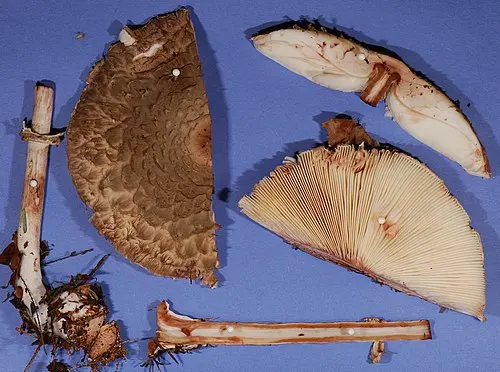 Madjack74 / CC BY-SA 3.0
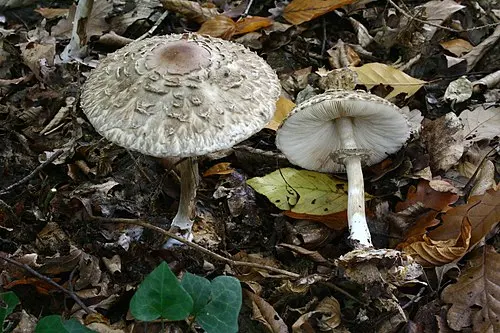 Strobilomyces / CC BY-SA 3.0