

About this fungus
Shaggy Scalycap is a fungus in the Strophariaceae family. Its habitat and field characteristics are summarised below.
A conspicuously shaggy mushroom that usually pushes up in dense clusters from a tree base, stump or buried wood. Straw-yellow to orange-brown caps and stems are covered with coarse tawny or dark brown scales, giving a fresh cluster a prickly, unkempt appearance.
What to check
Check that the cap surface between the scales is dry, not sticky. The gills are crowded and broadly attached, beginning pale or yellowish and maturing through olive-yellow or cinnamon tones to rusty brown. A young cobwebby veil leaves a fragile ring or ring zone, with a smoother pale stem above it and conspicuous scales below. A rusty to cinnamon-brown spore print separates it from white-spored Honey Fungus. Odour is useful when present but varies geographically, from radish-like to garlic-like, and some collections have little distinctive smell.
Variation
The background cap can be very pale straw-yellow in young mushrooms or much darker yellow-ochre to orange-brown in older ones. Scale size, colour and density also vary, and rain or age can flatten or remove some scales. European guides often describe a radish-like smell, while North American collections may smell of garlic or have no strong odour. Mature gills can show olive tones before becoming cinnamon or rusty brown.
Lookalikes
Pholiota squarrosoides is the closest match and cannot always be separated confidently in the field. Its cap is usually sticky beneath the scales, its gills pass from whitish to rusty brown without a greenish stage, and its spores are substantially smaller. Honey Fungus also forms large clusters at tree bases but gives a white rather than brown spore print and lacks the same combination of coarse cap and stem scales. Pholiota flammans is brighter orange-yellow and normally fruits from decaying conifer wood.
Habitat and range
Saprotrophic and sometimes a weak parasite, fruiting from stumps, dead wood, buried roots and the bases of living or dead trees. Broadleaf hosts are common in Europe, especially beech, but hardwoods and conifers are both documented across its wider range. Dense clusters at a living tree base may accompany existing root or butt decay rather than showing that the fungus attacked a healthy tree first. It fruits mainly from summer into autumn in temperate regions.
Food safety
Poisonous.
Photographs
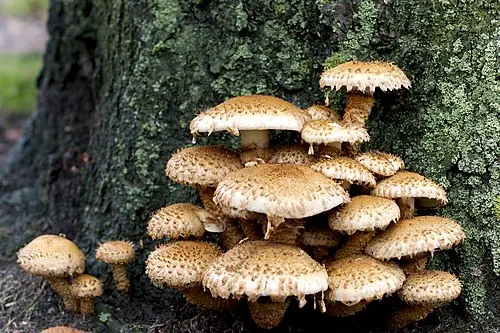 Villy Fink Isaksen / CC BY-SA 3.0
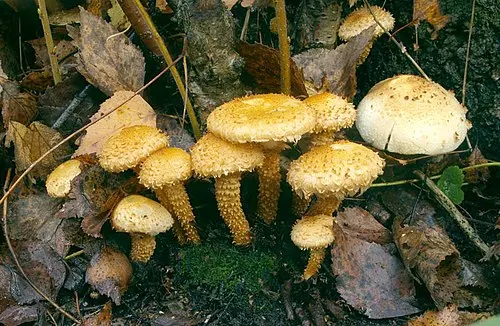 Igor Lebedinsky / CC BY 3.0