
About this fungus
Sheathed Woodtuft is a fungus in the Strophariaceae family. Its habitat and field characteristics are summarised below.
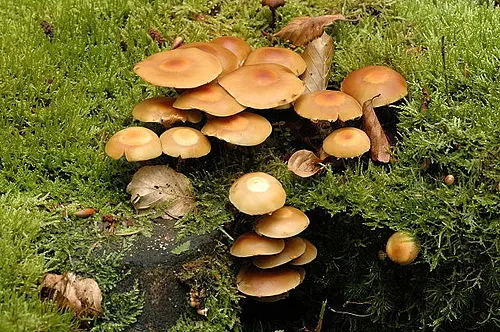
A dense tuft of small tawny to orange-brown mushrooms growing from a stump, log or buried wood. Damp caps are smooth, shiny and dark, then dry to yellow-tan, often leaving a striking pale centre inside a darker wet rim. The narrow stems usually share a common base and become darker and more scaly below a ring.
What to check
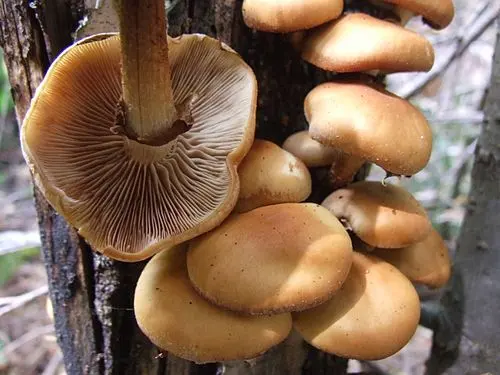
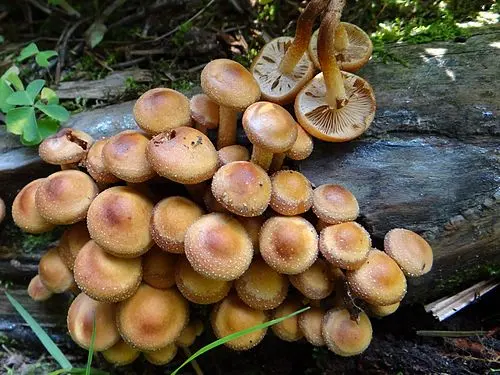
Check the whole group rather than one cap. Look for crowded attached gills that begin cream or pale tan and mature cinnamon-brown, a cinnamon-brown spore print, and a ring or ring zone. Above the ring the stem is pale and relatively smooth; below it the stem becomes brown towards the base and is usually clothed in small upturned scales. The cap normally dries paler from the centre, but its colour boundary moves as moisture changes. For difficult collections, microscopy is far more dependable: Sheathed Woodtuft has small smooth spores with a clear germ pore and its cap does not turn red with KOH.
Variation
A wet cap can be uniformly deep orange-brown, a partly dry cap can be sharply two-toned, and a fully dry cap can be almost uniformly pale ochre. Young caps may carry a few pale veil fibres near the edge. Rings range from a clear pale skirt with a brown edge to a ragged ring zone, while lower-stem scales can wear away. These changes explain why a single photograph or cap colour is not enough for a confident identification.
Lookalikes
Funeral Bell, Galerina marginata, is the critical lookalike. It overlaps in size, brown hygrophanous colour, ring, brown spores, season and growth on both hardwood and conifer wood, and it contains deadly amatoxins. It more often has a longitudinally fibrous rather than coarsely scaly lower stem and a cap that stays darker centrally, but neither field difference is absolute. Its larger ornamented spores and red cap reaction to KOH provide stronger separation. Conifer Tuft, Hypholoma capnoides, has grey-brown to purplish-brown mature gills, a purplish-brown print and no persistent ring. Honey Fungus species have a white spore print. Never use smell or a sample from one part of a mixed wood-growing cluster as proof of identity.
Habitat and range
Saprobic on dead wood, usually in dense clusters on broadleaf stumps, felled trunks and logs, especially birch and beech. It can also occur on conifer wood, and buried timber can make a group appear to grow from the ground. It is widespread across Europe, Asia, North America and Australia. Fruiting is most abundant from summer through autumn, but can extend through much of the year in mild climates.
Food safety
Edible, with caution.
Use this profile to learn what to examine and compare, not as proof that a mushroom is safe to eat. Check the whole specimen and every important lookalike before reaching an identification.
Photographs
 Jerzy Opioła / CC BY-SA 3.0
 Jerzy Opioła / CC BY-SA 3.0