
About this fungus
Sheep Polypore is a fungus in the Albatrellaceae family. Its habitat and field characteristics are summarised below.
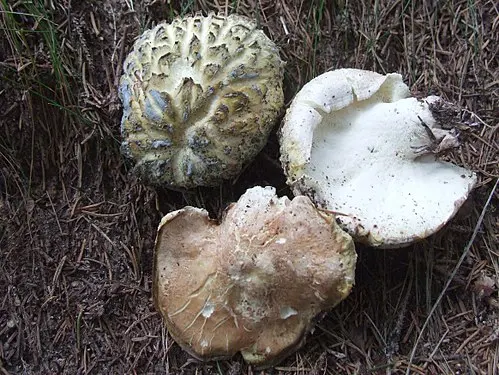
A pale, chunky ground-growing polypore of conifer woods, often forming fused irregular caps rather than brackets on a trunk.
What to check
Look underneath for tiny white to cream pores running onto a short stout stem, not gills. The pore surface and damaged areas may yellow, and old caps become cracked or grey-buff. There is no ring or volva.
Variation
Caps begin white or cream and age through yellowish, buff, grey or pale brown. Several fruit bodies often fuse, creating irregular lobed clusters.
Lookalikes
Albatrellus subrubescens and A. citrinus overlap strongly in colour and staining. A. Some North American material historically called A. ovinus may belong to related regional taxa.
Habitat and range
A terrestrial mycorrhizal fungus with conifers in northern and mountain forests. European accounts strongly associate it with spruce, while broader records include pine and other conifers.
Food safety
Edible.
Use this profile to learn what to examine and compare, not as proof that a mushroom is safe to eat. Check the whole specimen and every important lookalike before reaching an identification.
Photographs
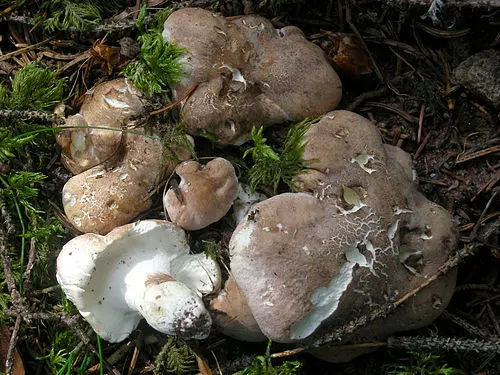 Bernypisa / CC BY-SA 3.0