

About this fungus
Shield Dapperling is a fungus in the Agaricaceae family. Its habitat and field characteristics are summarised below.
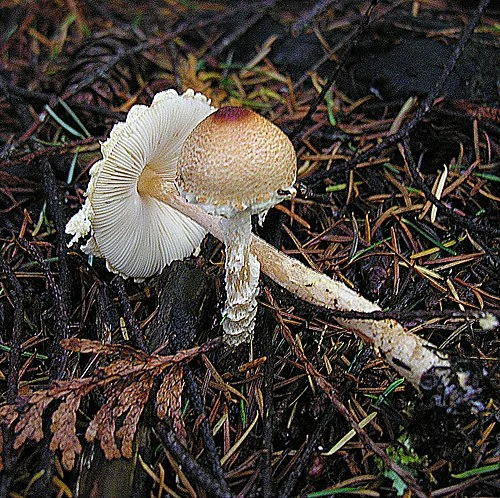
A slender woodland dapperling with a soft cream-white cap that develops a pale ochre to brown centre and fine woolly scales. White veil tatters often fringe the cap edge, while the lower stem looks shaggy or loosely wrapped in cottony bands. The cap opens from bell-shaped to broadly convex and sometimes nearly flat, usually keeping a low central bump.
What to check
Look for crowded free white gills, a white spore print and a dry cap whose pale surface splits into fine fibrillose scales. The fragile veil leaves a hanging ring or collapsed ring zone, with a smoother pale stem above it and conspicuous woolly fibres below. The whole base should be checked: it may be slightly club-shaped but has no volva. Odour is variable and may be weak, unpleasant, spicy or slightly gas-like, so it is supporting evidence rather than a deciding character. Spore shape and measurements are often needed for a confident species identification.
Lookalikes
Lepiota magnispora is the closest widespread match and has often been labelled as Shield Dapperling in older North American guides. It tends to have brighter colour, a more sharply contrasting dark cap centre and yellowish rather than white veil remnants, but reliable separation uses the longer, differently shaped spores. Lepiota ignivolvata has an orange to red-brown band low on a smoother stem and smaller spores. Several other small Lepiota are difficult to distinguish and some, including Lepiota subincarnata and Lepiota brunneoincarnata, contain deadly amatoxins. The much larger Parasol has a snakeskin-patterned stem and a thick movable ring; size alone is not a complete safety test.
Habitat and range
Saprobic in forest-floor litter and rich soil, fruiting singly or in small groups in broadleaf, mixed and conifer woodland. European records include beech and mixed deciduous woods, while carefully studied North American collections have often come from conifer forest. It usually appears from summer into autumn in northern temperate regions. The exact distribution is uncertain because the name has frequently been confused with Lepiota magnispora and may cover more than one closely related lineage.
Food safety
Inedible.
Photographs
 Dick Culbert / CC BY 2.0