

About this fungus
Silky Rosegill is a fungus in the Pluteaceae family. Its habitat and field characteristics are summarised below.
A large silky white to cream mushroom growing directly from hardwood, with free gills that mature pink, no stem ring and a substantial cup-like volva at the base.
What to check
Confirm direct growth from dead hardwood or a damaged area of a living tree. Mature gills and the spore print should be pinkish-brown, the gills are free from the stem, and there is no ring. Expose the full cup-like volva. Young gills can still be white, so immature specimens cannot be separated safely from pale Amanita by gill colour alone.
Variation
The cap starts oval or conical and opens through bell-shaped to broadly convex or nearly flat. Its white silky fibres can yellow or brown with age, especially near the centre, and the volva also darkens from white to yellow-brown.
Lookalikes
Pale Amanita species are the critical comparison because they can also have white young gills and a volva, and some are deadly. Mature pink spores, absence of a ring and direct growth from wood support Volvariella, but none should be used alone. Volvopluteus gloiocephalus usually grows from soil, compost or grass rather than intact hardwood.
Habitat and range
Saprotrophic on hardwood logs, stumps, cavities and wounds of living broadleaf trees. It is reported from Europe, Asia and North America, but North American collections show enough variation that future DNA study may refine the species concept.
Food safety
Edible, with caution.
Use this profile to learn what to examine and compare, not as proof that a mushroom is safe to eat. Check the whole specimen and every important lookalike before reaching an identification.
Photographs
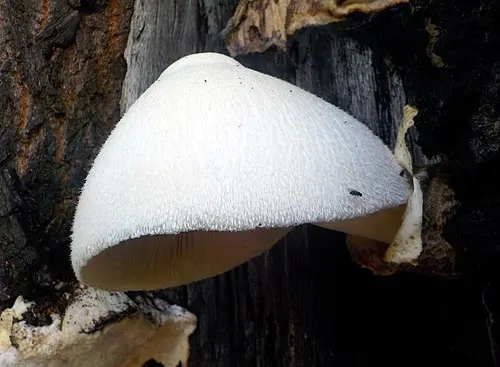 Albarubescens / CC BY 4.0
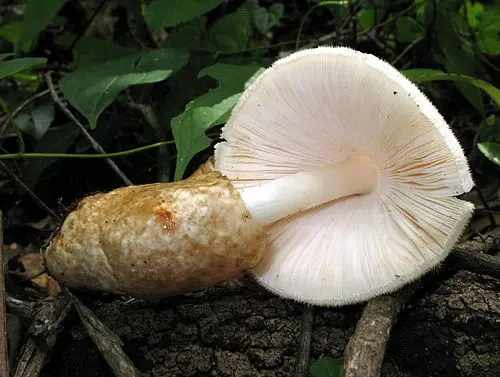 Richard Kneal / CC BY-SA 3.0