
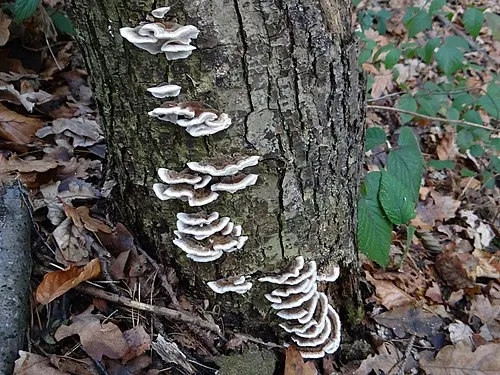
About this fungus
Smoky Polypore is a fungus in the Meruliaceae family. Its habitat and field characteristics are summarised below.
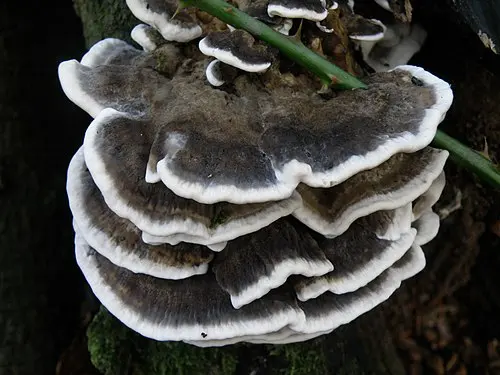
A thin, tough bracket that commonly forms overlapping shelves or spreading crusts on dead wood. The upper surface is pale grey, buff or brown, but the smoky grey underside is the more useful character.
What to check
Turn fresh material over and look for very small true pores, grey away from the pale growing edge and often darkening towards black with age or handling. The grey pore layer is distinct from the thin pale flesh. There is no stem, ring or volva.
Variation
Growth may be shelf-like, partly crust-like or almost completely flat against the wood. Crowded brackets can fuse into irregular rows, and older upper surfaces may become more strongly brown and zoned.
Lookalikes
Turkey Tail, Trametes versicolor, is more vividly zoned above and has a white or cream pore surface. Smoky Bracket can resemble Bjerkandera fumosa, which is usually thicker and larger, with a buff pore surface separated from the flesh by a dark line. An upper-surface photograph alone may not settle that comparison.
Habitat and range
A white-rot fungus found mainly on dead broad-leaved wood, including fallen branches, logs and stumps. It occasionally occurs on conifer wood and is widespread across temperate parts of Europe, Asia and North America.
Food safety
Inedible.
Photographs
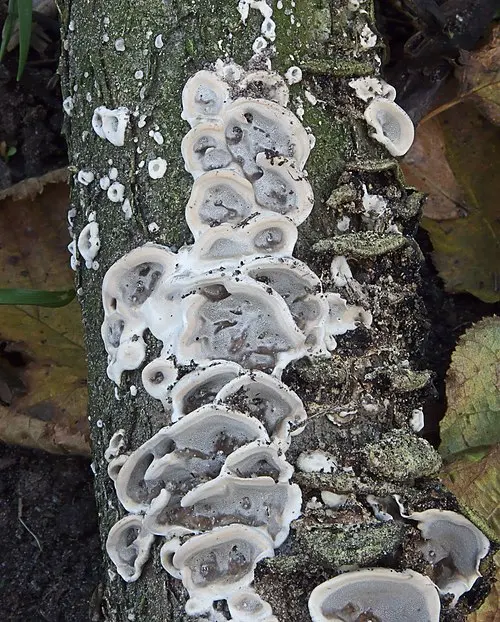 Rasbak / CC BY-SA 3.0
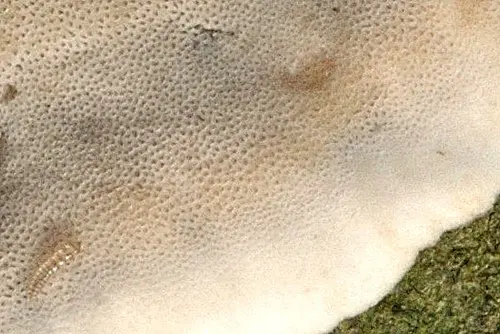 James Lindsey / CC BY-SA 3.0
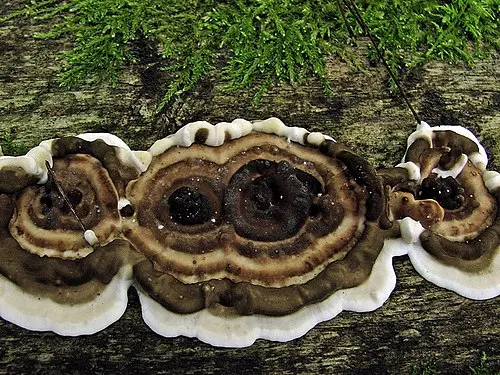 Bob (Bobzimmer) / CC BY-SA 3.0
 Josh Milburn (J Milburn) / CC BY-SA 3.0