

About this fungus
Snapping Bonnet is a fungus in the Mycenaceae family. Its habitat and field characteristics are summarised below.
A very slender grey-brown bonnet with a long flexible stem, usually rising from buried twigs or bark in woodland litter.
What to check
Look for a small striate cap, whitish gills and a long grey-brown stem with a woolly base attached to buried wood. When gently stretched lengthwise, the stem can break with a distinct snap. This is useful supporting evidence, but many small bonnets still need microscopy for a secure species identification.
Variation
The cap ranges from beige to grey-brown, usually darker at the centre and paler near the lined margin. It begins conical or bell-shaped and can broaden with age. Wet caps may feel slightly sticky.
Lookalikes
Many Mycena species share the same small grey bonnet shape. Mycena galopus releases white latex when its stem is broken, while Snapping Bonnet does not. Cap colour and the snapping stem are not enough on their own when a precise record is required.
Habitat and range
Saprotrophic on buried twigs, bark and other small woody debris in broadleaved or mixed woodland. It is recorded in Europe, North America and other temperate regions.
Food safety
Inedible.
Photographs
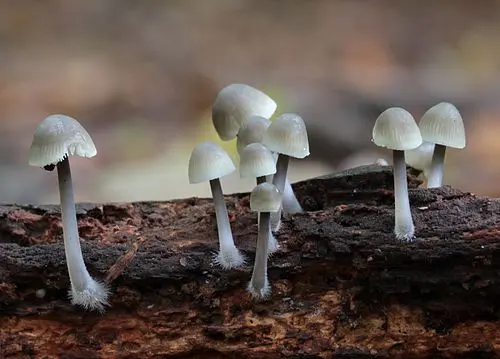 Stu's Images / CC BY-SA 3.0
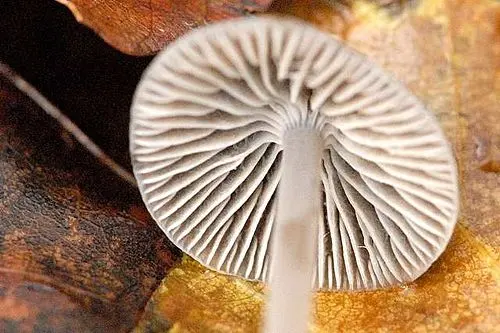 James K. Lindsey / CC BY-SA 3.0