
About this fungus
Snowy Waxcap is a fungus in the Hygrophoraceae family. Its habitat and field characteristics are summarised below.
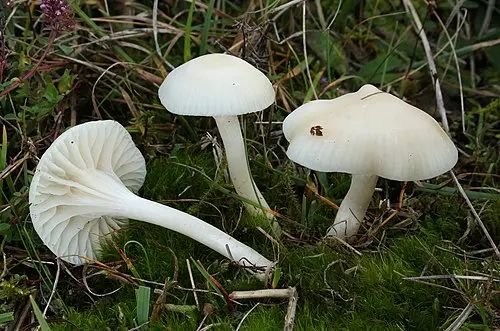
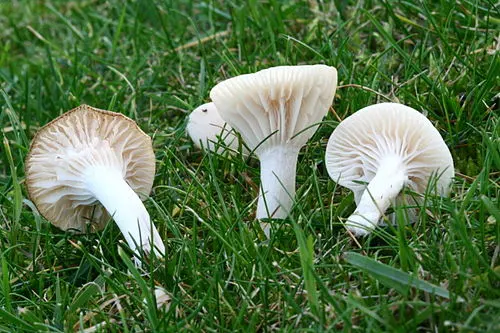
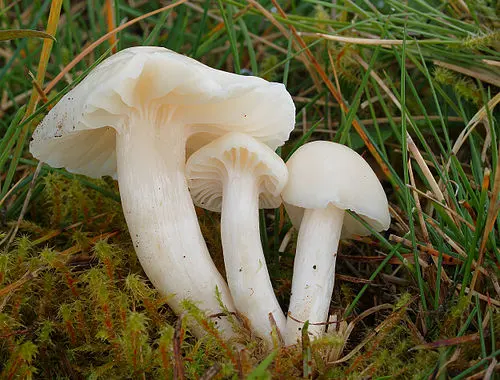
A small ivory-white waxcap that often appears in short grass. The moist cap begins rounded or gently pointed and becomes almost flat, usually keeping a low central bump. Its thick, widely spaced gills curve well down the slender white stem.
What to check
Look for thick, waxy and very widely spaced gills that run clearly down the stem. The cap is moist or faintly greasy rather than heavily slimy, and the white stem is often curved. There is no ring or volva and the spore print is white. Colour alone is not enough because several unrelated grassland mushrooms are also pale.
Variation
Fresh caps are usually ivory-white but can develop a pale yellow, cream, buff or light brown tone, especially near the centre. The surface may become translucent and faintly striate when wet. Older gills often change from bright white to ivory, and occasional mould infection can add an unusual purplish stain.
Lookalikes
Cedarwood Waxcap, Cuphophyllus russocoriaceus, is very similar but has a distinctive cedarwood or pencil-shaving smell. Pale forms of other Cuphophyllus may need microscopy. Ivory Woodwax and related Hygrophorus are usually more slippery, have closer gills and grow with trees. Small white grassland funnels such as Clitocybe rivulosa have thinner, more crowded gills rather than the broad waxy spacing seen here.
Habitat and range
Most familiar from old lawns, pasture, parkland, churchyards, fixed dunes, heath and other short grassland, often fruiting in troops. It tolerates some past disturbance and fertiliser residue better than many waxcaps, so its presence alone does not prove an untouched site. In northern Asia and North America it is also recorded from woodland. Its nutritional relationship with grasses, mosses and soil remains incompletely understood.
Food safety
Edible.
Use this profile to learn what to examine and compare, not as proof that a mushroom is safe to eat. Check the whole specimen and every important lookalike before reaching an identification.
Photographs
 Strobilomyces / CC BY-SA 3.0
 Andreas Kunze / CC BY-SA 3.0
Species to compare
Similar mushrooms to compare against: