

About this fungus
Spindleshank is a fungus in the Omphalotaceae family. Its habitat and field characteristics are summarised below.
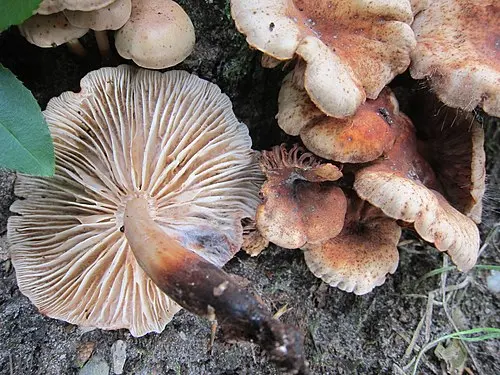
A tough reddish-brown mushroom forming dense clumps from buried roots or wood at the base of broadleaved trees, especially oak.
What to check
The stem is firm and spindle-shaped, often swollen in the middle then tapering into a rooting base, with longitudinal grooves and darker reddish-brown colour below. Gills are relatively widely spaced and become spotted brown with age. There is no ring or volva. Confirm connection to roots or buried wood rather than relying on apparent soil growth.
Variation
Caps fade from reddish-brown to tan and may become irregular or cracked in dry weather. Old stems become very dark, twisted and split lengthwise.
Lookalikes
Other clustered Gymnopus and Collybiopsis species usually lack the deeply rooting, swollen and grooved stem. Honey mushrooms have a different fibrous build and often a ring, while some ringless Armillaria need closer examination. Rooting habit and white spore print support the identification, but old photographs may remain ambiguous.
Habitat and range
A parasite and decomposer on roots, root collars, stumps and buried wood of broadleaved trees, most often oak and also beech. It can cause substantial root rot even when the fruit bodies appear some distance from the trunk.
Food safety
Edible.
Use this profile to learn what to examine and compare, not as proof that a mushroom is safe to eat. Check the whole specimen and every important lookalike before reaching an identification.
Photographs
 Henk Monster / CC BY 3.0