

About this fungus
Split Fibrecap is a fungus in the Inocybaceae family. Its habitat and field characteristics are summarised below.
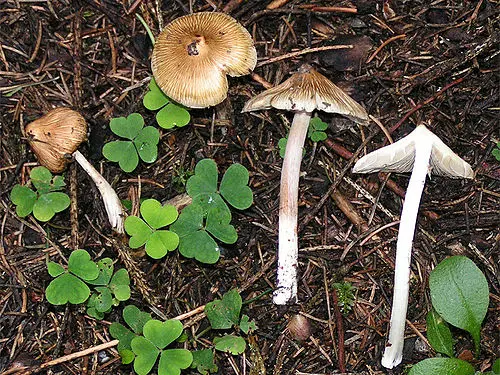
A slender straw-yellow to yellow-brown fibrecap with a pointed conical or bell-shaped cap. As the cap expands, its silky radial fibres pull apart and split towards the margin, producing the cracked appearance behind both of its English names. The pale, insubstantial build can look very different from the smaller, dark brown Torn Fibrecap, Inocybe lacera.
What to check
Look for a dry silky cap with a sharp central umbo and straight radial fibres that separate as it opens. The close gills begin whitish or creamy-grey with pale edges, then become grey-brown or olive-brown as the brown spores mature. The slender whitish to pale yellow stem has no ring, no volva and normally no distinct bulb. Odour may be absent, mealy, earthy or otherwise hard to describe, so it is weak evidence. Confirmation usually needs microscopy: the smooth elliptic to slightly bean-shaped spores occur with thin-walled cystidia on the gill edge and no pleurocystidia on the gill face.
Variation
Cap colour runs from pale straw and ochre-yellow to yellow-brown, often darker at the centre, and older or dry caps can be much more deeply split than young damp ones. Gills pass through cream, grey, olive and brown tones as they mature. The traditional Inocybe rimosa name covered a broad and variable species concept, and modern work recognises numerous similar Pseudosperma whose differences may not be visible in a field photograph.
Lookalikes
Torn Fibrecap, Inocybe lacera, is normally smaller with a darker walnut-brown, more densely hairy or scaly cap and unusually long, narrow spores. Pseudosperma sororium and other members of the Pseudosperma rimosum group can be extremely close and may require DNA as well as microscopy. Inosperma erubescens begins pale but develops conspicuous brick-red staining and can cause severe muscarine poisoning. The edible St George's Mushroom can fruit at the same time, but it is much fleshier, keeps white gills and lacks the strongly radial split cap. Colour or season alone is not enough for a species identification.
Habitat and range
Mycorrhizal with a wide range of broadleaf and conifer trees. It fruits singly, scattered or in groups in woodland, parks, cemeteries and beside paths, on firm or loose humus-rich soil. European records often mention beech, while North American accounts include both hardwoods and conifers. Fruiting can run from spring through autumn, and into winter in mild climates.
Food safety
Poisonous.
Photographs
 Eric Steinert / CC BY-SA 3.0