
About this fungus
Star Pinkgill Mushroom is a fungus in the Entolomataceae family. Its habitat and field characteristics are summarised below.
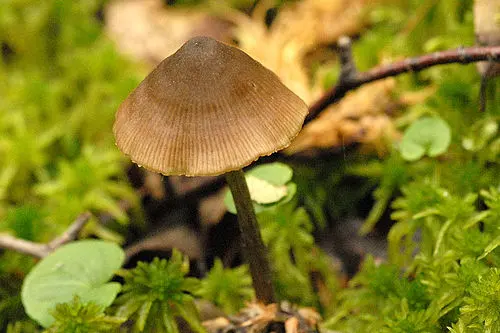
A small, slender pinkgill with a pointed brown cap that becomes much paler as it dries. Its English name refers to the unusual many-angled spores, so a confident species identification normally needs microscopy.
What to check
The cap begins bell-shaped or convex and develops a broad central bump, often with a translucent-lined margin. Its sinuate gills are almost free from the stem, starting whitish and maturing through pink to pink-brown. The slender brownish stem has conspicuous silvery longitudinal fibres and no ring. A pink spore print places it among the pinkgills, but the irregular star-shaped spores provide the key species-level confirmation.
Variation
Fresh moist caps range from grey-brown through reddish-brown to dark brown. They are strongly hygrophanous and may fade to a much paler buff as they dry. The cap edge can become wavy, and the pink colour of the gills is most obvious after spores mature.
Lookalikes
Many small brown Entoloma species overlap in shape and colour, and several require microscopic comparison. Entoloma rhodopolium usually fruits in woodland and often develops a flatter cap with a sharper central bump, but habitat alone is not decisive. This record should remain at genus level unless the star-shaped spores or equivalent expert evidence have been checked.
Habitat and range
Saprobic, usually in small groups in lawns, pastures, parkland, stable dunes, golf courses and other low-nutrient grassland, with occasional records from grassy woodland clearings. European accounts place the main season from summer into late autumn, while timing varies with local climate.
Food safety
Inedible.
Photographs
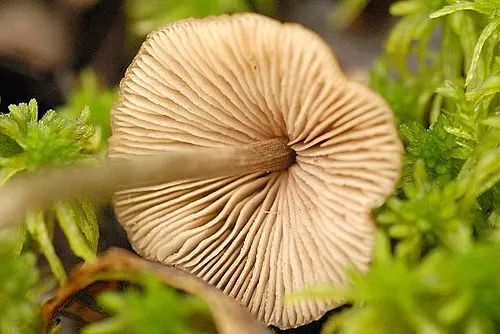 James Lindsey / CC BY-SA 3.0
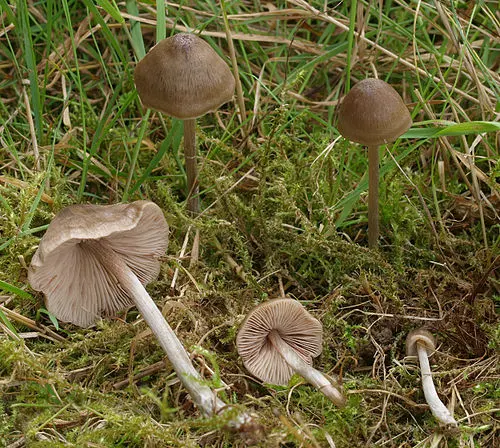 Andreas Kunze / CC BY-SA 3.0
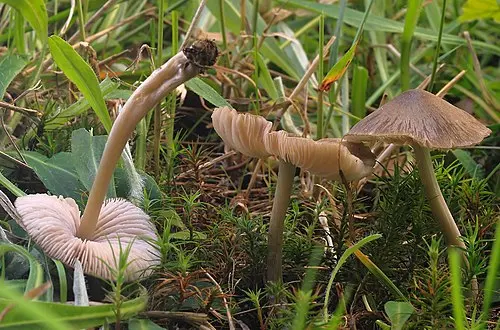 Andreas Kunze / CC BY-SA 3.0