
About this fungus
Stinking Dapperling is a fungus in the Agaricaceae family. Its habitat and field characteristics are summarised below.
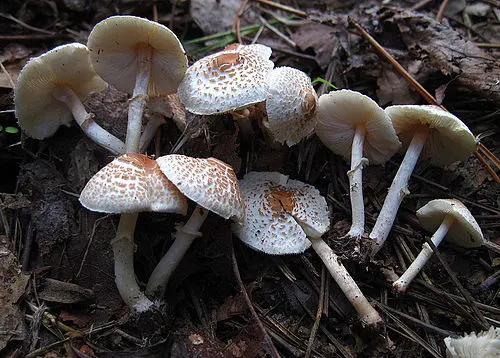
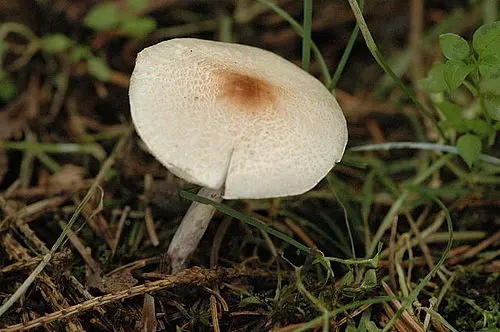
A small, slender dapperling with a cream-white cap, a smooth reddish-brown central disc and fine brown scales arranged in rough concentric rings. The cap begins ovoid or bell-shaped, opens through convex to almost flat and can turn up or become shallowly depressed when old. Its thin build and unpleasant rubbery or gas-like odour are useful first impressions, but neither is unique to this species.
What to check
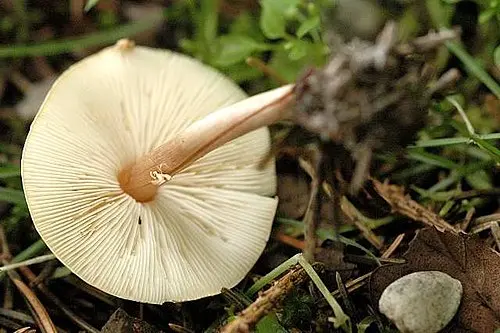
Look for crowded free gills that begin white or cream, a white spore print and a slender pale stem with no volva. A thin membranous ring may be visible on a young specimen but is fragile and often disappears. The darker cap centre should remain fairly smooth while the surrounding surface breaks into small red-brown scales over a pale background. Odour varies from strongly rubbery or fishy to much less obvious, so it should support the other characters rather than decide the identification. Microscopy is often needed to confirm a small Lepiota.
Variation
Young caps may be tightly ovoid with the scales barely separated. As they expand, the pale background becomes more obvious and the scales may fade or wash away, leaving an older cap much plainer. The gills usually remain pale but can become cream, buff or slightly brownish with age. The ring can vanish completely, and both cap colour and odour vary across the wider Lepiota cristata group.
Lookalikes
Lepiota ignivolvata has a conspicuous orange to red-brown ring or band low on the stem. In western North America, Lepiota castaneidisca can be very close; it tends to grow in forest and has a rounder red-brown cap, while true Lepiota cristata is often found in parks, roadsides and other disturbed ground. Several species can only be separated reliably with microscopic or DNA evidence. Small Lepiota also include deadly amatoxin-containing species such as Lepiota subincarnata and Lepiota brunneoincarnata. The much larger Parasol has a thick movable ring and a snakeskin-patterned stem, but an undersized or damaged collection should never be judged by size alone.
Habitat and range
Saprobic on leaf litter, woodchips and nutrient-rich soil. It occurs singly, scattered or in small groups in mixed woodland, damp shady gardens, lawns, parks, path edges, roadsides and other disturbed places. Records span temperate regions of Europe, Asia and North America, but some reports outside Europe belong to a group of similar species rather than a securely confirmed Lepiota cristata.
Food safety
Poisonous.
Photographs
 James Lindsey / CC BY-SA 3.0
 James Lindsey / CC BY-SA 3.0