
About this fungus
Stinking Orange Oyster is a fungus in the Phyllotopsidaceae family. Its habitat and field characteristics are summarised below.
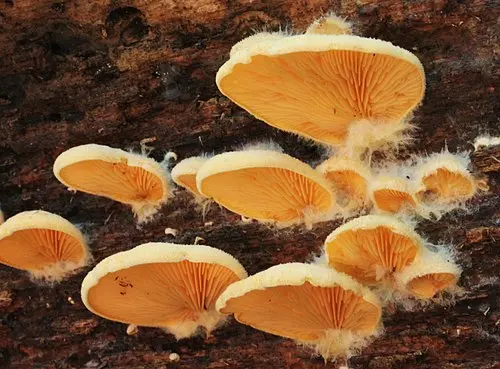
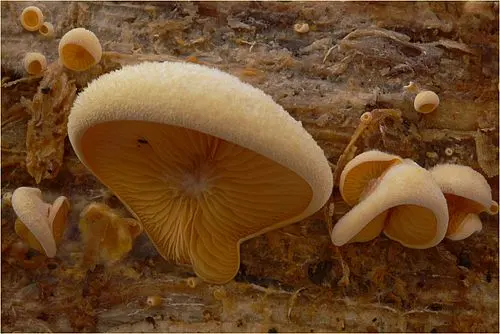
A vivid orange, fan-shaped gilled mushroom growing in overlapping shelves on dead wood. Its upper surface is densely hairy or woolly, while the crowded gills are orange too. Many fresh collections have a strong unpleasant smell, but some do not.
What to check
Prioritise visible characters rather than smell alone: a dry fuzzy orange cap, close orange gills, little or no lateral stem, and growth directly from dead wood. A very pale pink to peach spore print is a useful separator from true oyster mushrooms. Odour may resemble rotten cabbage, rotten eggs or skunk cabbage, but it can be mild or absent.
Lookalikes
True oyster mushrooms, Pleurotus species, usually have smoother white, grey or brown caps and a white to pale lilac-grey print rather than a pinkish print. Crepidotus crocophyllus can be orange and hairy but develops a brown spore print. Tapinella panuoides has yellow-brown, often forked and wrinkled gills. Cap texture, gill colour and spore print are more dependable than the common name or smell alone.
Habitat and range
A white-rot saprotroph on recently dead and decaying logs, stumps, trunks and branches of both broad-leaved and coniferous trees. It can grow singly but more often forms overlapping shelves. It occurs across northern temperate regions and often fruits in cool weather from autumn through winter, with timing varying by climate.
Food safety
Inedible.
Photographs
 Lebrac / CC BY-SA 3.0