

About this fungus
Stubble Rosegill is a fungus in the Pluteaceae family. Its habitat and field characteristics are summarised below.
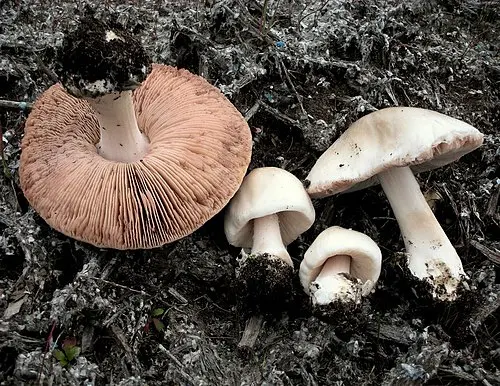
A large, pale mushroom of nutrient-rich open ground, with a white to grey-brown cap that is sticky when damp and silky when dry.
What to check
Excavate the whole stem base and confirm a white, bag-like volva. The stem has no ring. In mature specimens the free gills change from white to pinkish brown and the spore print is pink-brown. Young specimens do not yet show the useful pink colour, so they cannot be separated safely from pale Amanitas by gills alone.
Variation
The cap ranges from white to grey-brown and can have darker radial streaks. The sticky surface is most noticeable in wet weather.
Lookalikes
Pale Amanita species can share a volva and may be deadly. Their mature gills and spore print remain white, but a ring may be lost and young gills can also look white. Some regional Volvopluteus species are extremely similar, so mature features and geographic scope matter.
Habitat and range
Saprotrophic on enriched or disturbed soil, including stubble fields, manured grassland, compost, gardens and roadside verges. North American collections may include closely related regional species.
Food safety
Edibility is uncertain or disputed.
Photographs
 Ron Pastorino / CC BY-SA 3.0