
About this fungus
Sulphur Knight is a fungus in the Tricholomataceae family. Its habitat and field characteristics are summarised below.
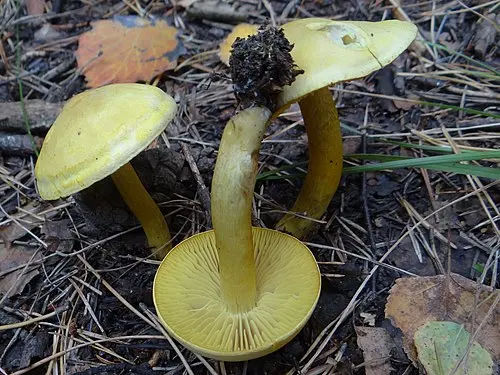
A sulphur-yellow woodland mushroom whose cap, gills, flesh and stem all carry the same striking colour. The dry cap begins convex and often becomes wavy, flatter or slightly depressed while retaining a low central bump. Its powerful gas-like smell is usually apparent at close range.
What to check
Check for broad, widely spaced sulphur-yellow gills that are notched just before they meet the stem. The yellow stem has no ring or volva, and the spore print is white. The strong smell, often compared with coal gas, sulphur or burnt rubber, is an important clue, but combine it with the all-yellow flesh and gills rather than identifying by smell or cap colour alone.
Variation
The yellow cap may develop olive, reddish-brown or occasional purplish tones, especially around its centre. Mature caps can become irregular or slightly depressed, while sheltered young fruit bodies may remain evenly yellow.
Lookalikes
Yellow Knight, Tricholoma equestre, normally has a browner or olive central area and lacks the same strong gas-like smell. Tricholoma bufonium has a more purple-brown cap and may represent part of the same variable complex in some treatments. Other yellow Tricholoma can overlap in colour, so check gills, smell, spore colour and tree association together.
Habitat and range
Ectomycorrhizal on woodland soil, principally with broad-leaved trees such as beech and oak, although it is occasionally recorded with conifers. It fruits mainly from late summer through autumn across Europe, with records also from Asia and North America.
Food safety
Poisonous.
Photographs
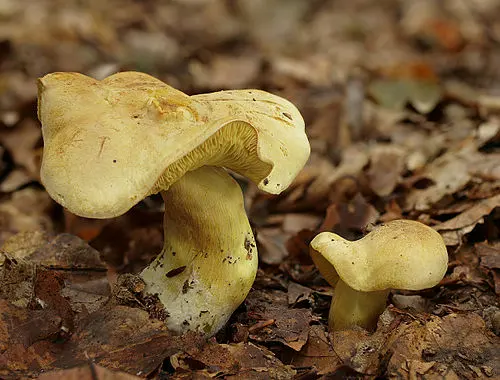 Andreas Kunze / CC BY-SA 3.0