
About this fungus
Surprise Webcap is a fungus in the Cortinariaceae family. Its habitat and field characteristics are summarised below.
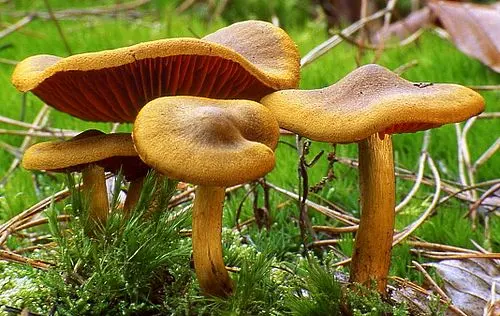
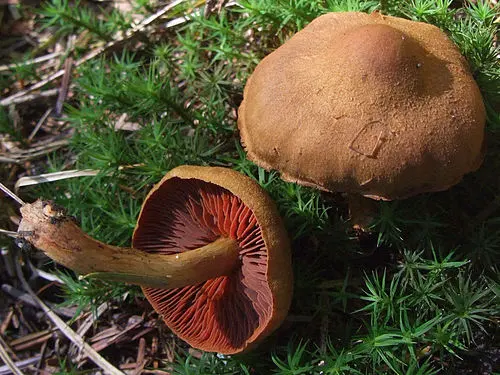
A slender woodland webcap whose dull yellow-brown to olive-brown cap hides a striking underside of blood-red gills. The cap is dry and finely silky, often with a broad central bump, while the stem is pale yellowish to ochre and may redden near the base. The sudden flash of red when it is turned over explains the common name.
What to check
Check young specimens for a fine yellowish cortina linking the cap edge to the stem. It soon tears and may leave only a rusty fibrous zone rather than a true ring. The close gills should begin blood red, then become cinnamon or rusty brown as the spores mature; the spore print is rusty brown. There is no volva. A mild radish-like odour can support the identification but may be faint. A drop of potassium hydroxide on the cap turns promptly purple to purplish black, although this is a specialist test and not unique enough to replace microscopy.
Variation
The cap ranges from yellow-brown and cinnamon to darker olive-brown, usually with a darker centre, and may be broadly bell-shaped, convex or nearly flat. Young gills can vary from orange-red to deep blood red and may show little red once mature spores have coated them. The stem ranges from pale yellowish to ochre or whitish, sometimes with red-orange fibres near the base. Colour and spore size vary across the wider species concept, especially in North American material.
Lookalikes
Bloodred Webcap, Cortinarius sanguineus, is red across the cap, gills, stem and flesh rather than having a dull brown cap over red gills. Cortinarius cinnamomeus usually has yellowish to orange gills rather than blood-red ones. Other red-gilled webcaps can overlap closely and may require microscopy and DNA evidence. The genuinely orellanine-containing Deadly Webcap and Fool's Webcap belong to Cortinarius section Orellani and usually have a more uniform orange-brown to red-orange cap and stem with yellow-brown to rusty gills, not the sharp dull-cap and blood-red-gill contrast seen here. They are still important safety lookalikes for anyone trying to identify a brown webcap from incomplete material.
Habitat and range
Mycorrhizal with conifers, especially pine and spruce, and also recorded with birch. It grows singly, scattered or in groups on mossy woodland floors, often on acidic, nutrient-poor or sandy soil. Fruiting is mainly from summer into autumn across northern temperate regions of Europe and North America.
Food safety
Inedible.
Photographs
 Jerzy Opioła / CC BY-SA 4.0