

About this fungus
Tacked Milkcap is a fungus in the Russulaceae family. Its habitat and field characteristics are summarised below.
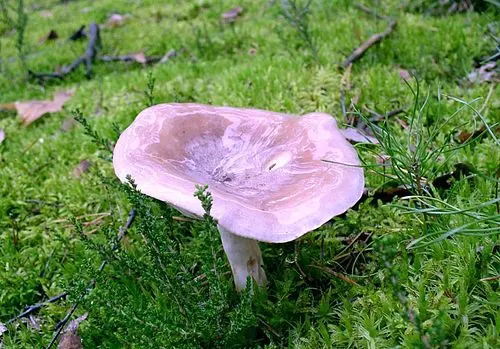
A large northern milkcap with a smooth grey-lilac to grey-brown cap that becomes conspicuously sticky or slimy when wet. The pale gills release abundant white latex, and the stout stem often becomes hollow.
What to check
Check the wet, slippery cap, abundant white latex, pale attached to slightly decurrent gills, hollowing stem and damp birch or conifer habitat. Latex may slowly yellow or leave grey-green marks. Similar large milkcaps overlap strongly, so host, spores and cap-surface microscopy may be needed.
Variation
Fresh wet caps can be violet-grey and glossy, while dry or older caps become dull grey-brown, ochre or yellow-brown. The centre becomes depressed with age. Latex quantity and staining are less obvious in dry weather.
Lookalikes
Lactarius utilis and other pale sticky milkcaps can be very similar. Lactarius vietus is usually smaller and greyer, with different latex changes. Regional keys, tree association and microscopic features are more reliable than cap colour alone.
Habitat and range
Mycorrhizal in wet boreal and northern temperate woodland, especially with birch and spruce and often among Sphagnum. It is chiefly Eurasian; superficially similar milkcaps in other regions should be assessed with local references.
Food safety
Edible.
Use this profile to learn what to examine and compare, not as proof that a mushroom is safe to eat. Check the whole specimen and every important lookalike before reaching an identification.
Photographs
 Игорь Лебединский / CC BY 3.0