

About this fungus
Tawny Funnel Cap is a fungus in the Tricholomataceae family. Its habitat and field characteristics are summarised below.
A tawny-orange woodland mushroom that often forms troops, arcs or rings in deep litter. Its cap becomes broadly depressed or funnel-shaped, with crowded pale gills running well down the stem.
What to check
Look for a 4 to 10 cm smooth buff to orange-brown cap with a wavy margin that is inrolled when young. The cream to pale tawny gills are crowded and strongly decurrent. The spore print is pale cream to pinkish cream, and the finely ornamented spores help separate it from similar funnels. There is no ring or volva.
Variation
Young caps can be convex and pale buff, later becoming tawny, rust-orange and deeply funnelled. The former names Lepista inversa and L. flaccida were applied to conifer-litter and broadleaf-litter forms, now generally treated within one variable species.
Lookalikes
Common Funnel, Infundibulicybe gibba, is often paler and has smooth rather than ornamented spores, but field separation can be unreliable. Poisonous Paralepistopsis amoenolens can overlap in appearance in parts of southern Europe and North Africa and is associated with a strong aromatic smell. Other pale Clitocybe-like funnels include muscarine-containing species, so a general funnel shape is not a food identification.
Habitat and range
Saprobic in leaf litter, needle litter, humus-rich soil, compost and woodchip, in broadleaved, coniferous and mixed woodland. It often fruits in groups or rings, mainly in cooler wet parts of the local season.
Food safety
Edibility is uncertain or disputed.
Photographs
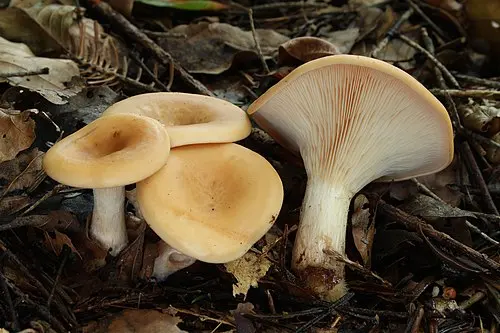 H. Krisp / CC BY 3.0
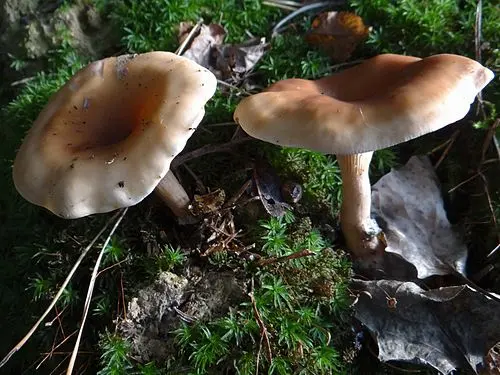 Jerzy Opioła / CC BY-SA 3.0
Species to compare
Similar mushrooms to compare against: