

About this fungus
Tawny Grisette is a fungus in the Amanitaceae family. Its habitat and field characteristics are summarised below.
A slender ringless Amanita with a smooth tawny-orange to orange-brown cap, a strongly grooved margin and a white sac-like volva around the stem base.
What to check
Expose the complete stem base and confirm a membranous white sack, often marked rusty brown. Check the strongly striate cap margin, free crowded white gills, white spore print and absence of a stem ring. A missing ring alone is never enough, because rings can be undeveloped, fragile or lost in other Amanita species.
Variation
Young specimens remain partly enclosed by the universal veil and can look like pale eggs. The tawny cap and grooved margin become clear only as the mushroom opens. Cap veil patches are usually absent but can occasionally persist, while the volva often develops orange-brown stains.
Lookalikes
Other ringless grisettes, including grey and orange members of the Amanita vaginata group, can be very similar and regional species concepts differ. More importantly, deadly Amanita species can also begin as enclosed buttons and may lose or hide a ring. Any unopened specimen, damaged base or incomplete collection must remain unidentified rather than being assigned to Tawny Grisette.
Habitat and range
A mycorrhizal woodland fungus associated with trees including birch, oak, alder, sweet chestnut, pine and spruce. The name is most securely applied in Europe and parts of northern Asia; similar ringless Amanita species occur elsewhere.
Food safety
Edibility is uncertain or disputed.
Photographs
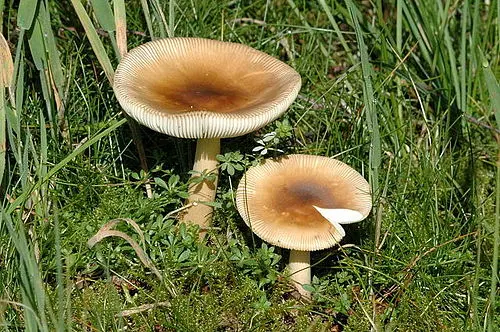 James Lindsey / CC BY-SA 3.0
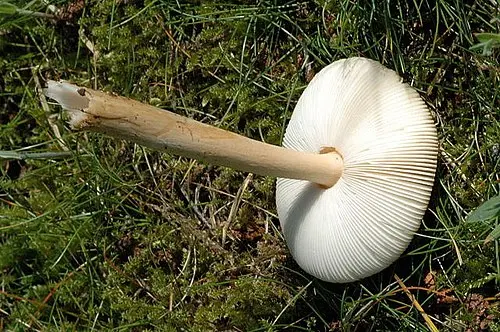 James Lindsey / CC BY-SA 3.0
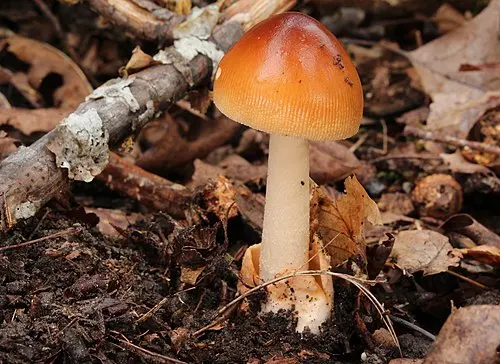 H. Krisp / CC BY 3.0