
About this fungus
The Flirt is a fungus in the Russulaceae family. Its habitat and field characteristics are summarised below.
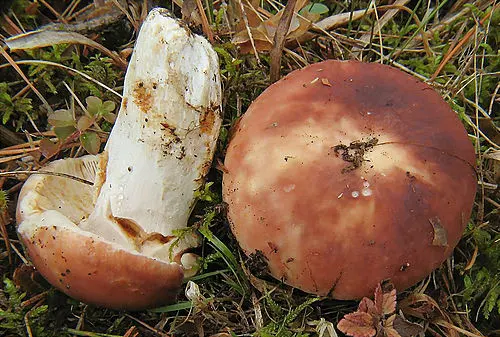
A firm, solid brittlegill with a smooth cap whose colour may resemble old ham, muted wine red, pink-brown or buff. On mature caps the coloured skin often stops about a millimetre short of the rim, leaving a narrow pale strip of exposed flesh and gill ends visible from above.
What to check
Look for firm brittle flesh with no latex, a white ringless stem and a white spore print. The white to very pale cream gills are fairly close, narrow and often fork near the stem. Most importantly, the mature cap cuticle may fail to reach the outer rim, exposing a thin pale margin; separately, that cuticle can usually be peeled roughly halfway towards the centre. These are two different features. Colour is variable, and confident Russula identification may still require spores, cap-surface microscopy or chemical reactions.
Variation
Caps range from deep wine red or dull pink through brown and buff, sometimes with olive or greenish areas. They begin rounded to convex and later flatten or develop a shallow central depression. The exposed pale rim is most evident on expanded mature caps and may be weak or absent on young, damaged or unusually developed specimens, so it should support rather than dictate an identification.
Lookalikes
Many red-brown Russula species overlap in cap colour. Crab Brittlegill, R. xerampelina and its relatives, usually develop a fish or shellfish smell and often stain yellow-brown. Other similar red Russulas may require a white spore print, microscopic spore ornamentation and cap-surface features to separate. Do not assume a pink-brown brittlegill is R. vesca from colour alone.
Habitat and range
An ectomycorrhizal woodland species most often associated with beech and oak in European accounts, but also recorded with other broad-leaved trees and with spruce on neutral to acidic soils. Reported occurrence is broad across temperate Eurasia and in parts of North America, although regional Russula identification should follow local treatments. It generally fruits from summer into autumn.
Food safety
Edible.
Use this profile to learn what to examine and compare, not as proof that a mushroom is safe to eat. Check the whole specimen and every important lookalike before reaching an identification.
Photographs
 AfroBrazilian / CC BY-SA 3.0