

About this fungus
The Miller is a fungus in the Entolomataceae family. Its habitat and field characteristics are summarised below.
A soft-looking white, buff or pale-grey mushroom with a dry, finely suede-like cap. Mature caps are often wavy or irregular rather than neatly round, and a strong smell of flour, dough or watermelon rind is characteristic.
What to check
Check that the gills run clearly down the stem, begin whitish and become pinkish as the spores mature. The spore print is brownish pink. The short white stem is solid, sometimes off-centre, and has neither a ring nor a volva. Use the cap texture, decurrent gills, mature pink colour, spore print and smell together. No one feature is enough to separate every pale lookalike.
Variation
The cap ranges from white through buff to pale grey and may show a cream or pinkish cast. It starts convex with an inrolled edge, then becomes flat, wavy or irregular. Young gills can look almost white, while mature ones become distinctly pinkish.
Lookalikes
Poisonous pale funnels including Clitocybe rivulosa and Clitocybe dealbata can look similar but retain a white spore print. Entoloma sinuatum is another dangerous pale, pink-spored comparison, although it is usually larger with gills that are not deeply decurrent. Smell can vary and should not be used as the sole safety check.
Habitat and range
Saprotrophic on soil in open hardwood or conifer woodland, grassy woodland clearings, tracksides, hedgerows and parkland. It grows alone, scattered or in groups, mainly from summer through autumn across temperate parts of Europe and North America.
Food safety
Edible.
Use this profile to learn what to examine and compare, not as proof that a mushroom is safe to eat. Check the whole specimen and every important lookalike before reaching an identification.
Photographs
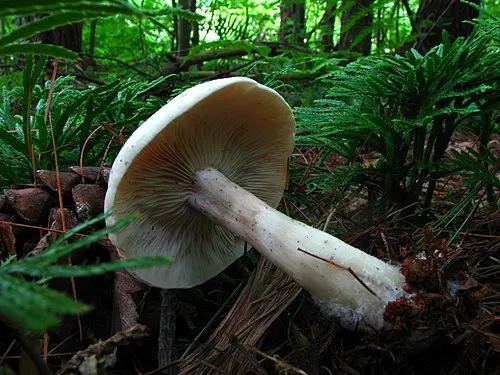 Dan Molter / CC BY-SA 3.0
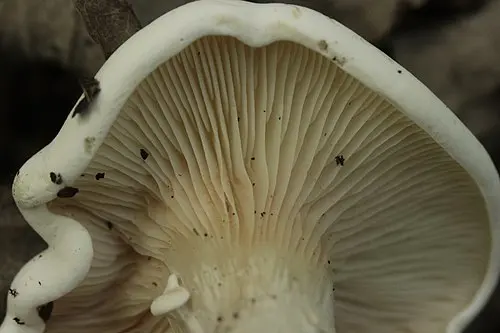 Björn S. / CC BY-SA 2.0
Species to compare
Similar mushrooms to compare against: