
About this fungus
The Prince is a fungus in the Agaricaceae family. Its habitat and field characteristics are summarised below.
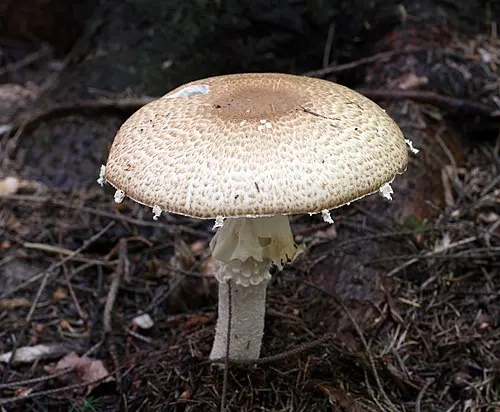
A very large woodland Agaricus with a cream cap densely covered in reddish-brown fibrillose scales and a substantial skirt-like ring.
What to check
Confirm free gills that mature from pale grey-pink to dark chocolate-brown, a brown spore print, a large ring and no volva at the fully excavated base. The almond or marzipan-like odour and slow yellowing support the identification but can vary.
Variation
Caps expand from rounded to broad and flat, with scales becoming more separated. Odour and yellowing may weaken in old or dry specimens.
Lookalikes
Poisonous yellow-staining Agaricus usually turn vivid chrome-yellow rapidly at the stem base and often have a phenolic or inky odour, but both reactions can be weak. Young Amanita retain white gills and may have a volva. North American Agaricus julius was historically included under this name in the Rocky Mountains.
Habitat and range
Saprotrophic in conifer and broad-leaved woodland, edges, gardens and other rich soil. Geographic scope matters because similar scaled Agaricus differ regionally.
Food safety
Choice edible.
Use this profile to learn what to examine and compare, not as proof that a mushroom is safe to eat. Check the whole specimen and every important lookalike before reaching an identification.
Photographs
 Jason Stajich (stajich) / CC BY-SA 3.0
 mushroomexplorer / CC BY-SA 3.0
 Tim Sage (T. Sage) / CC BY-SA 3.0