

About this fungus
Thin-walled Maze Polypore is a fungus in the Polyporaceae family. Its habitat and field characteristics are summarised below.
A tough, stalkless bracket with concentric grey, ochre and reddish-brown zones across its upper surface. The pale underside has elongated or maze-like pores and often develops pink to reddish-brown marks where fresh tissue is pressed.
What to check
Turn the bracket over. Its pore surface varies from round or angular pores to branching radial slots and shallow maze patterns. Fresh pale pores may blush pink-red when handled, but old or dry brackets can react weakly. The cap is thin, corky, radially wrinkled and attached directly to hardwood, with no stem, ring or volva.
Variation
Young caps are pale tan to ochre with a whitish edge. Mature brackets develop stronger red-brown, purple-brown and grey zones, while old surfaces may darken or become green with algae. Pore shape is unusually variable, so a fully maze-like underside is not required.
Lookalikes
Oak Mazegill, Daedalea quercina, is usually thicker, grows mainly on oak and has deeper coarse maze-like channels. Birch Mazegill, Trametes betulina, has more clearly blade-like folds below. Daedaleopsis tricolor has a darker cap and a consistently more gill-like underside, although its taxonomic treatment varies between sources.
Habitat and range
Causes white rot on dead or dying broad-leaved wood, especially willow and also alder, birch, poplar and other hardwoods. It is often found in damp woodland and beside rivers and is widely recorded across temperate Europe, Asia and North America.
Food safety
Inedible.
Photographs
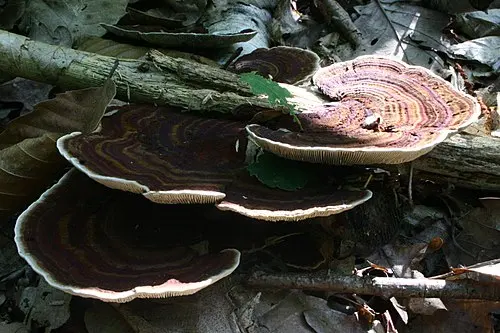 Strobilomyces / CC BY-SA 3.0
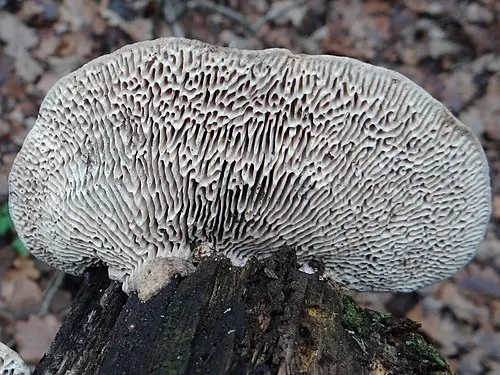 Jerzy Opioła / CC BY-SA 3.0
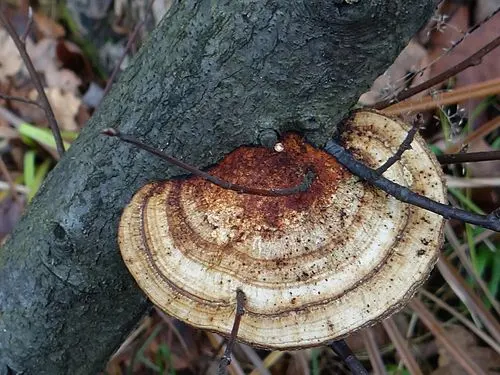 Jerzy Opioła / CC BY-SA 3.0
Species to compare
Similar mushrooms to compare against: