
About this fungus
Tiger's Eye is a fungus in the Hymenochaetaceae family. Its habitat and field characteristics are summarised below.
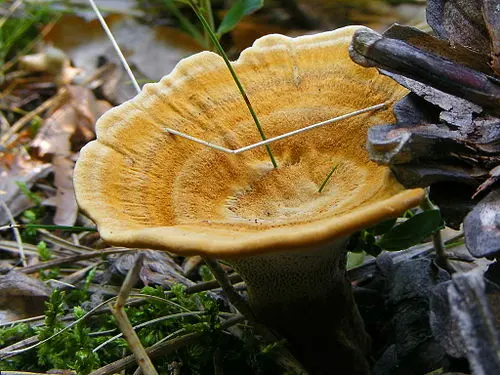
A thin, tough, funnel-shaped polypore rising from the ground on a short central stem. Concentric bands of ochre, cinnamon, brown and red-brown create the tiger-eye pattern, while the paler wavy margin often remains actively growing.
What to check
Turn it over to find small grey-brown pores, not gills. The tubes may meet the stem directly or run a short way down it. Check for a dark brown velvety central stem, leathery flesh and a golden-brown spore print. The combination of a stalked polypore and growth from soil is more useful than colour alone.
Variation
Young caps are finely downy and strongly banded. With age they become smoother, radially furrowed and duller. Nearby stems can fuse, producing compound caps with two or more depressed centres.
Lookalikes
Coltricia cinnamomea is usually smaller and more silky or shiny, but regional Coltricia species concepts are not fully settled and microscopy may be needed. Turkeytail, Trametes versicolor, forms zoned rosettes on wood and has white pores and a white print. Onnia species are thicker and also need habitat and microscopic comparison.
Habitat and range
Usually on poor sandy or acidic ground in conifer woodland, heaths, path edges, clearings and old fire sites. It is widespread across temperate regions and should be recorded as ground-growing even when buried roots or woody debris lie immediately beneath it.
Food safety
Inedible.
Photographs
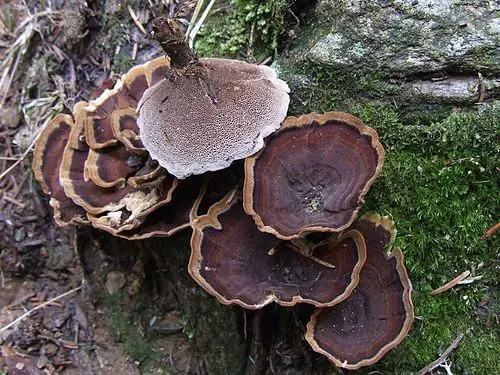 Jerzy Opioła / CC BY-SA 3.0