
About this fungus
Tiger Sawgill is a fungus in the Polyporaceae family. Its habitat and field characteristics are summarised below.
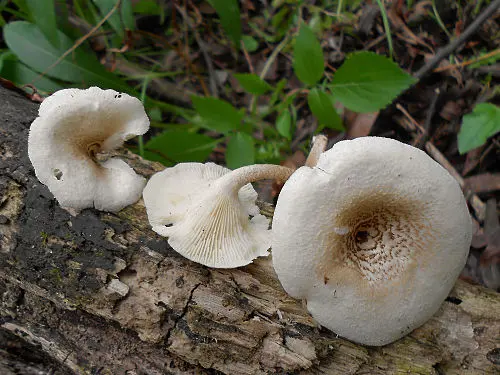
A small, tough wood-growing mushroom with a pale cap, a navel-like central depression and fine dark brown scales that create a tigered pattern.
What to check
Look underneath for crowded cream gills that are broadly attached or run down the stem and develop slightly serrated edges. The stem is fibrous and often finely scaly, with a short-lived ring zone near the top when young. Confirm growth from wet hardwood and the central cap depression rather than relying on the scale pattern alone.
Variation
Cap scales can be bold or rather sparse, and older stems may lose both their scales and ring zone. North American collections can form an abnormal enclosed form in which the gills are malformed or covered by veil-like tissue. This is part of the species' variation, not a separate ordinary lookalike.
Lookalikes
Trainwrecker is usually larger and more robust, favours conifer wood and commonly has coarser cap scales and a more evident veil. Dryad's Saddle has a scaly cap on hardwood but has pores rather than gills. Similar sawgills should be compared using host, cap shape, ring zone and microscopic characters where necessary.
Habitat and range
Saprobic on dead hardwood, especially willows, poplars and other trees in riverbanks, floodplains and woodland that is regularly wet. It occurs across several continents, but genetic work shows geographically separated populations within the wider Lentinus tigrinus complex.
Food safety
Edible and good.
Use this profile to learn what to examine and compare, not as proof that a mushroom is safe to eat. Check the whole specimen and every important lookalike before reaching an identification.
Photographs
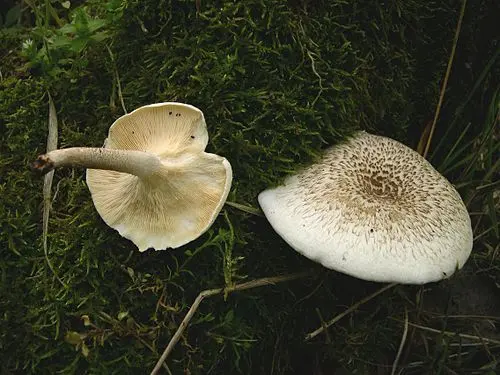 Archenzo / CC BY 3.0