

About this fungus
Torn Fibrecap is a fungus in the Inocybaceae family. Its habitat and field characteristics are summarised below.
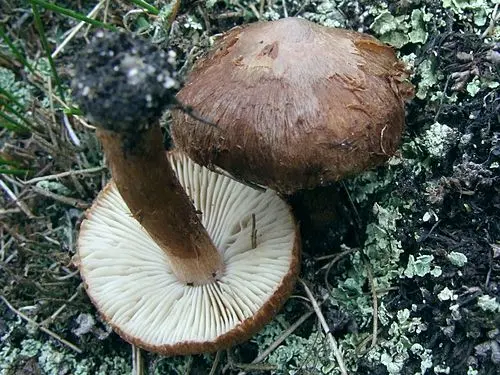
A small walnut-brown to very dark brown fibrecap with a dry cap covered in dense radial fibres or fine scales. Young caps are rounded, conical or bell-shaped, then broaden and may split or look ragged at the edge. The lower stem often becomes much darker than the upper part. These are useful signs of the Torn Fibrecap group, but its closest relative cannot be separated reliably by field appearance alone.
What to check
Look for pale gills that are attached to the stem and mature through beige and ochre to reddish-brown, sometimes with an olive cast, while the edges often stay paler. A young specimen can carry a thin pale cobweb-like cortina between cap and stem, but this soon disappears and does not leave a lasting ring. There is no volva. A fleeting white veil may dust the youngest cap before revealing the darker fibres beneath. For a secure species identification, examine the unusually long, narrow, smooth spores and the shape of the cystidia under a microscope.
Variation
Cap colour ranges from medium walnut-brown to almost blackish brown, and the surface may be densely fibrous, finely scaly or visibly split. Young caps can appear paler where remains of the white veil persist. The gills change markedly as the brown spores mature. It grows from coastal dunes to alpine ground and occurs in both dry sandy and wet boggy settings, so neither moisture nor elevation defines it on its own.
Lookalikes
Inocybe moravica is the closest known relative and may share the same habitat. It tends to have a grey rather than white young veil, a more shaggy-scaled cap, wider and more varied spores and shorter stem cystidia, but dependable separation may need microscopy and DNA. Split Fibrecap, Pseudosperma rimosum, is usually larger and paler, with a straw-yellow to yellow-brown pointed cap that splits along straighter radial fibres; its spores are elliptic to slightly bean-shaped rather than long and narrow. Many other fibrecaps are small and brown, and photographs alone are rarely enough for a confident species name.
Habitat and range
Mycorrhizal with conifers and broadleaf trees and shrubs. Recorded partners include pine, spruce, birch, willow, oak and beech, as well as dwarf willow and Dryas in alpine ground. It is most frequent on acidic soil and can fruit in woodland, heath, sandy dunes, bogs and high mountain habitats. Records extend across Europe and North America and into parts of Asia and the Southern Hemisphere. Fruiting is mainly from summer through autumn, with spring records in some regions.
Food safety
Poisonous.
Photographs
 Jerzy Opioła / CC BY-SA 3.0