

About this fungus
Tripe Fungus is a fungus in the Auriculariaceae family. Its habitat and field characteristics are summarised below.
A tough, gelatinous bracket that forms overlapping shelves on dead broadleaved wood. The upper surface is hairy and banded grey, brown and ochre, while the fertile underside becomes dark and strongly wrinkled, giving the species its common name.
What to check
Compare both surfaces. The upper face should be felted or hairy and concentrically zoned, while the underside is smoother when young but becomes veined and wrinkled. The flesh is gelatinous yet tougher than a typical Jelly Ear. It attaches broadly to wood and has no stem, gills, ring or volva.
Variation
Upper bands range through white, grey, ochre and brown and can become green with algae. The underside may begin pale and bloomed, then darken through reddish brown or purple-brown as it ages. Young or wet lobes can look more ear-like than mature tiered brackets.
Lookalikes
Jelly Ear, Auricularia auricula-judae, is usually smoother above and forms clearer ear-shaped cups rather than a hairy zoned bracket. Modern DNA work shows that tripe-like Auricularia outside Europe and Central Asia include related species that may be difficult or impossible to separate from photographs alone.
Habitat and range
Saprotrophic on dead and decaying broadleaved wood, including elm, beech, ash, maple and other hosts. Auricularia mesenterica in the strict modern sense is centred in Europe and Central Asia; similar tripe-like species occur in other parts of the world.
Food safety
Inedible.
Photographs
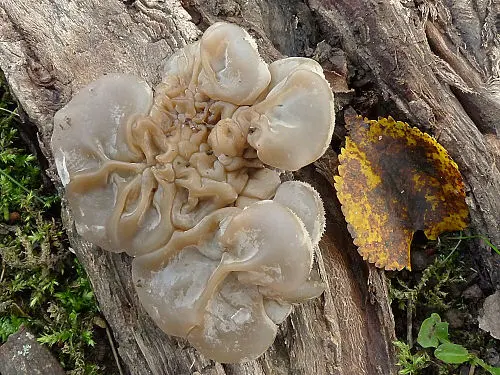 Jymm / CC BY-SA 3.0
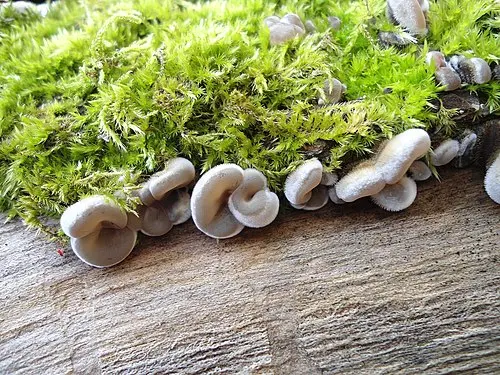 Dimitar Naydenov / CC BY-SA 3.0